
Dozens Killed as Myanmar Military Air Strikes Hit Wedding and School Sites
Air strikes by Myanmar's military have killed dozens of civilians across the nation, including at a wedding venue and a school.
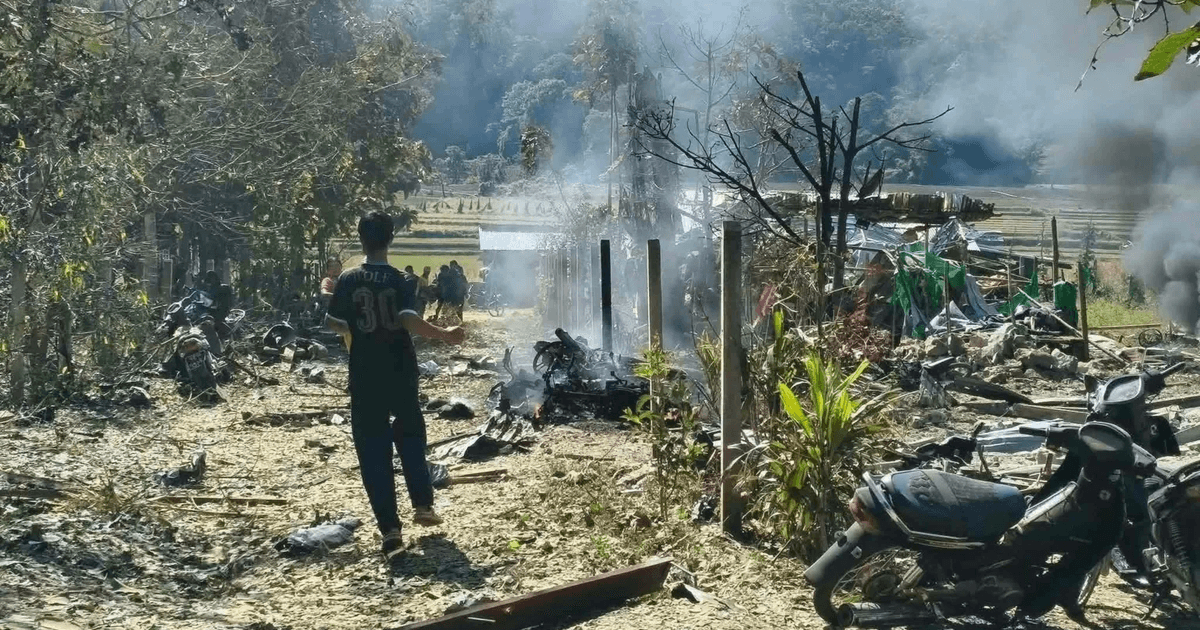
Air Strike Casualties Across Shan, Magway, and Rakhine States
According to reports from MyJoyOnline and AdomOnline, air strikes executed by Myanmar's military have killed dozens of civilians across multiple regions in rapid succession. The weekend campaigns targeted civilian infrastructure, striking a wedding venue in southern Shan state, a school in the central Magway region, and residential blocks in western Rakhine state. These violent operations mark a severe escalation in aerial bombardments following years of protracted civil conflict.
Quantifying the human toll requires examining documented regional tallies compiled by emergency responders and exiled administrative bodies. In Moe Bye village, rescue workers confirmed at least 21 fatalities and 35 injuries following Saturday afternoon munitions drops on a wedding ceremony. Just 48 hours prior, a separate aerial attack on In Yon village left at least 20 dead within educational grounds.
Displacement Ripple Effects in Shan
Following the Moe Bye strike, dozens of families fled to nearby forest shelters, fearing another raid. Aid trucks arrived three days later, delivering blankets and basic medicines, but the influx strained limited resources. Local leaders report that the sudden population surge has overwhelmed makeshift clinics that were already coping with malaria outbreaks.
Education System Disruption in Magway
The In Yon school bombing forced the closure of three neighboring schools, leaving roughly 1,200 students without classrooms. Teachers scrambled to arrange temporary lessons in community halls, yet the halls lack desks or chalkboards. Parents fear that prolonged interruptions will erode literacy gains achieved over the past decade.
Housing Crisis in Rakhine
In Mrauk-U town, the evening residential bombing shattered roofs and collapsed walls, rendering entire blocks uninhabitable. Residents salvaged whatever belongings they could carry, while the local council petitioned humanitarian agencies for emergency housing kits. The shortage of timber and cement has slowed reconstruction, pushing some families into prolonged tent camps.
The Moe Bye Village Wedding Venue Impact
The Saturday afternoon raid in Moe Bye village shattered a civilian gathering site in southern Shan state. Emergency responders on the ground registered 21 dead alongside 35 wounded participants. The high casualty count reflects the vulnerability of crowded public gatherings under modern aerial targeting.
Survivors described a scene of shattered tables, overturned chairs, and a lingering smell of burnt fabric. Many mourners lost relatives they had never met, deepening communal grief. Local elders now refuse to host large celebrations, fearing that future strikes could target any festive gathering.
In Yon Village School Bombardment Statistics
Thursday's strike in the Magway region targeted a school facility frequented by resistance sympathizers. According to the exiled National Unity Government, the raid killed at least 20 individuals, including young students, local teachers, and novice monks. Central Myanmar remains a primary zone of active armed opposition against the central government.
Parents who escaped the blast now keep children at home, fearing that the school yard could become a target again. The loss of teachers has left a void in subjects such as mathematics and science, which already suffer from textbook shortages. Community volunteers have begun informal tutoring sessions in private homes.
Image: myjoyonline.comOperational Mechanics of the Post-Coup Air Campaign
Daily aerial sorties have become the junta's primary method for projecting force into contested territories since the February 2021 coup deposed Aung San Suu Kyi's civilian government. Because ground divisions frequently struggle to secure insurgent-held ground, commanders rely heavily on fixed-wing assets and rotary gunships. This reliance shifts the burden of warfare directly onto civilian centers, schools, and infrastructure.
The tactical pattern involves dropping ordnance on locations where the central government faces territorial deficits. In Mrauk-U town, western Rakhine state, a residential bombing at approximately 20:00 local time killed more than 10 people and injured 20 others. This western urban zone remains under the operational control of the Arakan Army, one of the nation's most formidable ethnic armed organizations.
Air Assets Deployed by the Junta
Satellite imagery shows that the military fields a mix of older MiG-29 fighters, Chinese-made K-8 trainers retrofitted for strike missions, and Russian-supplied Mi-35 attack helicopters. These platforms can loiter for hours, allowing pilots to identify targets from high altitude before releasing precision-guided munitions. The presence of foreign spare parts suggests a supply chain that skirts international sanctions.
Logistical Chain Behind the Sorties
Fuel depots near Naypyidaw receive diesel shipments via rail, then trucked to forward airbases in Mandalay and Taunggyi. Maintenance crews work around the clock to keep aging airframes airworthy, often cannibalizing parts from grounded aircraft. The relentless tempo of missions has forced the junta to rotate crews every six sorties to avoid pilot fatigue.
In Mrauk-U town, the evening residential bombing at approximately 20:00 local time killed more than 10 people and injured 20 others. This western urban zone remains under the operational control of the Arakan Army, one of the nation's most formidable ethnic armed organizations.
Ethnic Armies and Territorial Contestation
Armed opposition groups maintain de facto administrative control over vast borderlands and rural districts. The Arakan Army and allied NUG-aligned defense forces force the military to rely almost exclusively on standoff air power. Yet, quantitative casualty data shows these strikes overwhelmingly impact non-combatant populations rather than fortified frontlines.
Field reports indicate that many ethnic fighters lack heavy artillery, pushing them to adopt guerrilla tactics that keep them mobile. This mobility frustrates ground offensives, prompting commanders to substitute bombs for boots. The resulting pattern leaves schools, markets, and homes in the crosshairs.
The Absence of Official State Comment
Myanmar's military-led government has declined to issue public statements regarding the multi-state bombing sequence. Independent verification of casualty numbers remains challenging due to widespread communications blackouts and strict military censorship across the World News beat. Exiled authorities and frontline rescue teams provide the primary stream of verifiable impact metrics.
Human rights NGOs have appealed to foreign embassies for satellite data that could corroborate on-the-ground accounts. So far, diplomatic channels have yielded only vague assurances, leaving journalists to piece together narratives from survivor testimonies and local radio broadcasts.
Image: myjoyonline.comGeopolitical Fallout Following the International Court Verdict
The intensification of air strikes coincides with severe diplomatic setbacks for the ruling regime on the international stage. One week prior to the bombings, the International Court of Justice issued a landmark ruling finding Myanmar guilty of committing genocide against the Rohingya minority. That historic legal decision stems from the 2017 military crackdowns that displaced over 700,000 people.
While the state consistently denies genocide charges by claiming its armed forces were responding to insurgent raids, the judicial verdict increases the junta's international isolation. Observers monitoring Politics note that domestic military escalation often accelerates when external legal pressure mounts. With villages burned and daily ground offensives continuing unabated, civilian populations absorb the immediate consequences of both judicial condemnation and tactical retaliation.
Regional Diplomatic Reactions
ASEAN members issued a joint statement urging restraint, but none have imposed concrete sanctions beyond travel bans on senior officers. The United Nations called for an emergency session on December 5 to discuss possible arms embargoes. Neighboring Thailand has tightened its border checkpoints, turning back dozens of refugees fleeing the latest bombings.
Humanitarian Aid Constraints
UN agencies report that the recent air raids have forced aid convoys to reroute around contested zones, adding up to 48 hours of travel time. Food pallets destined for displaced families now sit in warehouses awaiting clearance from military checkpoints. The delay risks exacerbating malnutrition rates that already hover near crisis levels in Rakhine.
With the International Court verdict looming over every diplomatic move, the junta appears to double down on aerial force as a bargaining chip. The next week will likely see another wave of sorties, and the world watches to see whether pressure can coax a pause in the bloodshed.
The Morning Brief
One email a day with the stories that matter. Free, forever.
No spam. Unsubscribe anytime.
Comments (0)
Be the first to share your thoughts.