
Airstrikes on Wedding Venue and Markets Kill at Least 30 Across Myanmar
At least 30 people were killed in three Myanmar military airstrikes targeting a wedding venue and markets, days after an international genocide ruling.
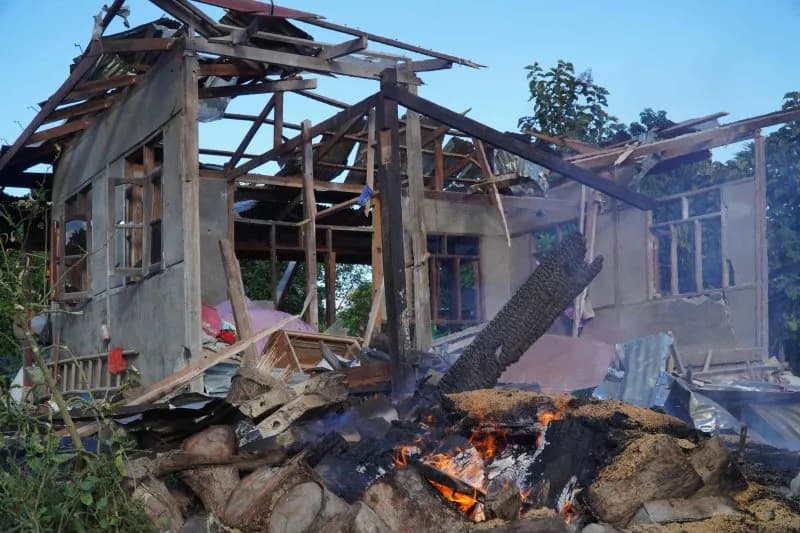
According to AFP, at least 30 people were killed in three separate Myanmar military airstrikes on Saturday, pushing the civilian death toll higher just days after an international court ruled the state had committed genocide. The synchronized bombings struck a wedding celebration in the country's northeast alongside multiple civilian hubs in the western state of Rakhine.
These latest fatalities arrive amid an ongoing civil war that monitoring groups estimate has claimed more than 100,000 lives since the 2021 military coup displaced elected leaders. Local medical teams and humanitarian organizations struggle to treat mounting casualties while rescue missions face continuous secondary strikes on active triage zones.
Reconstructing the Sequence of Bombings in Moe Bye and Rakhine
The violence unfolded across disparate regions over a single weekend, beginning with a devastating blast in the Moe Bye district along the borders of Shan and Karenni states. The military regime retains control of the town proper, though opposition groups operate heavily in the surrounding zones where thousands of displaced families have sought shelter.
Moe Bye Wedding Attack
Witnesses reported hearing an aircraft overhead moments before munitions struck a wedding venue hosting individuals displaced by the broader conflict. A local humanitarian coordinator confirmed that a secondary bomb was dropped directly onto the site after rescue workers arrived to pull survivors from the wreckage.
Survivors described a sky that darkened within seconds, followed by a thunderous roar that shattered makeshift tents. The first explosion flattened the banquet hall, while the follow-up strike ignited stored fuel drums, sending a fireball into the night sky.
Medical volunteers scrambled to extract victims from twisted metal, yet the second blast tore through their improvised triage area. The leader of the Nway Oo Yaung Chi Foundation later told reporters that at least 21 people died in the wedding venue strike alone, including five children, alongside more than 40 severe injuries.
Rakhine Market Assault
Parallel strikes struck western Rakhine state on Saturday, targeting a crowded local market in Mrauk-U and causing immediate fatalities among shoppers and vendors. Hla Maung Oo, head of a local funeral organization, confirmed that nine individuals died in the initial market bombing before a subsequent late-night strike hit the same vicinity.
Market stalls that sold fresh produce and household goods turned into piles of ash, and the second wave of ordnance struck while families gathered to retrieve the fallen. Residents said the air raid sirens failed to sound, leaving civilians with no warning before the bombs fell.
Video footage from the aftermath captured mourners wailing over rows of bodies laid out in makeshift community spaces as families searched the rubble for missing relatives. These regional attacks mirror an offensive days prior in central Myanmar's Magway region, where an assault on a school and monastery killed 29 people.
Coordinated Timing and Military Tactics
Analysts who have tracked flight paths note that the two attacks occurred within a four-hour window, suggesting a coordinated plan to overwhelm emergency responders. Satellite imagery released by an independent watchdog shows a single jet circling each target twice before releasing its payload.
The pattern of dropping a second bomb after first-responders arrive matches tactics used in previous campaigns against rebel-held towns. Military spokespeople have not offered an explanation, but a pro-military Telegram channel claimed the strikes aimed at “armed resistance fighters holding ceremonies.”
Civilian Casualties and Rescue Operations Under Fire
First responders faced immediate mortal peril as military aircraft circled back to drop secondary payloads onto active rescue zones in Moe Bye. The leader of the Nway Oo Yaung Chi Foundation, which supports displaced camp populations, confirmed at least 21 deaths in the wedding venue strike alone, including five children, alongside more than 40 severe injuries.
Witnesses documented harrowing encounters amid the dust and blood, including fathers carrying wounded children toward makeshift field clinics while navigating unverified aerial threats. The deliberate targeting of crowded social gatherings and civilian distribution points underscores a shifting tactical posture by junta forces against non-combatant populations.
As I ran carrying my daughter, I had only one thought — to save her life. Now she is gone, and there is little meaning in the fact that I am still alive.
— Hla Than Aung, Displaced Resident in Rakhine State
Independent verification remains severely constrained across conflict zones as telecommunications infrastructures falter and military censors restrict independent travel. A pro-military Telegram channel claimed that previous strikes on civilian-adjacent structures targeted armed resistance fighters holding ceremonies, contradicting teacher and witness accounts of parent-teacher gatherings.
Medical personnel across Shan and Rakhine states report running out of basic surgical supplies as road blockades prevent emergency ambulances from reaching regional hospitals. Blood bags, antibiotics and sterile gauze have become scarce commodities, forcing clinicians to improvise with limited resources.
Image: malaymail.comGeopolitical Fallout and Junta Defiance Following the ICJ Ruling
The weekend bombings followed a landmark ruling issued on November 19 by the International Court of Justice, which found that Myanmar state forces had committed genocide against the mostly Muslim Rohingya minority during a 2017 crackdown. Rather than complying with judicial mandates, military leader Min Aung Hlaing dismissed the verdict in state media addresses, stating his administration would ignore inappropriate legal demands.
International Legal Reaction
UN Secretary-General António Guterres called the airstrikes “a blatant violation of international humanitarian law” and urged the Security Council to consider new sanctions. Several European capitals announced they would freeze any remaining military-aid contracts pending a full investigation.
Human rights NGOs filed urgent petitions with the ICJ, asking the court to order immediate protective measures for civilians in the targeted regions. The petitions cite the fresh bombings as evidence that the junta continues to act in defiance of the court’s authority.
Regional Diplomatic Responses
ASEAN foreign ministers convened an emergency meeting in Jakarta, where Thailand and Indonesia urged “swift de-escalation” while Malaysia warned of a humanitarian spillover into its border towns. The bloc’s consensus statement stopped short of condemning the junta directly, reflecting deep divisions among member states.
China’s foreign ministry issued a brief statement expressing “concern” over civilian casualties but refrained from linking the deaths to the ICJ ruling. The ambiguous tone aligns with Beijing’s long-standing policy of shielding Myanmar’s military from Western pressure.
Economic Sanctions and Aid Freeze
Following the ruling, the United States re-imposed targeted sanctions on two senior junta officials linked to the air campaign. The Treasury Department cited “evidence of direct involvement in attacks on civilian gatherings” as the basis for the measures.
European Union aid agencies announced a temporary suspension of food-distribution programs in Rakhine until security guarantees can be verified. The pause threatens to leave an estimated 250,000 people without reliable nutrition supplies.
Humanitarian Dislocation and the Expanding Conflict Footprint
The Armed Conflict Location & Event Data Project notes that aerial bombardments have accelerated sharply as ground forces lose territorial control to the self-declared National Unity Government and allied People’s Defence Forces. Displaced populations numbering in the millions now find themselves trapped between active ground skirmishes and indiscriminate air power across border regions lacking air defense systems.
International humanitarian agencies warn that without immediate diplomatic intervention or enforcement mechanisms, civilian death tolls will continue to mount exponentially across rural townships. Food trucks, water purification units and mobile clinics are forced to relocate every few days to avoid becoming targets.
Local NGOs have begun mapping safe corridors using satellite data, hoping to guide aid convoys away from known flight paths. The maps, shared via encrypted messaging apps, have saved dozens of lives but remain vulnerable to sudden changes in military tactics.
Families forced to flee their homes now travel longer routes toward internally displaced-person camps in the central plains, where overcrowding fuels disease outbreaks. Cholera cases have risen by an estimated 30 % in the past month, according to a report from Médecins Sans Frontières.
As the conflict drags on, the stark reality on the ground is that civilians bear the brunt of a strategy that blends air power with psychological terror. Each new strike reshapes the map of safe havens, pushing more people into precarious conditions that no single aid organization can fully address.
Image: malaymail.comThe Morning Brief
One email a day with the stories that matter. Free, forever.
No spam. Unsubscribe anytime.
Comments (0)
Be the first to share your thoughts.