
Bode George Says PDP's 2027 Presidential Ambitions Hang on Supreme Court Ruling
Veteran PDP leader Chief Olabode George warns that the party's 2027 presidential bid hangs entirely on the Supreme Court's verdict in its leadership dispute.
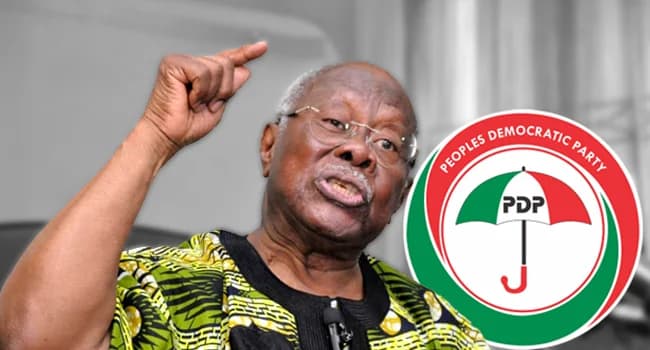
According to reporting from Punch, veteran Nigerian politician Chief Olabode George insists the Peoples Democratic Party will map out its path for the 2027 presidential election only after the Supreme Court resolves an ongoing, bitter internal leadership dispute. Speaking to reporters in Lagos on Sunday following his 81st birthday, the former Deputy National Chairman argued that shutting the main opposition out of the ballot would mark an unprecedented setback for the country's multi-party democracy.
The party remains split between a faction aligned with Federal Capital Territory Minister Nyesom Wike and an interim National Working Committee led by Dr Kabiru Turaki, leaving the platform's institutional machinery paralyzed as national political realignments accelerate across the country.
To understand the high-stakes friction now gripping the opposition, one must examine how local party structures and grassroots organizers experience this paralysis on the ground. State chapters and local delegates find themselves frozen between rival secretariats, unable to sell membership cards, organize congresses, or nominate candidates for local and federal races.
Party secretariats that once buzzed with campaign planning now sit quiet, caught in administrative limbo while lawyers trade motions across appellate benches. This localized paralysis drains campaign momentum long before any ballot box opens, leaving precinct workers unsure which leadership faction holds the legal authority to sign nomination forms.
The Factional Rift and Judicial Battles Threatening PDP Structures
The institutional fracture deepened following the disputed November 2025 national convention in Ibadan, which spawned the rival Turaki-led interim NWC that George's camp now backs. Subsequent rulings from the Federal High Court and the Court of Appeal upended that convention, while a separate legal bid by the Board of Trustees to force electoral commission recognition for the interim leadership was dismissed in July and upheld on appeal in November.
The Wike-aligned faction views these judicial victories as definitive proof of its legitimacy, pointing toward an alignment with the ruling administration's broader political orbit heading into 2027.
State-Level Fragmentation Across Regional Party Chapters
Regional chapters are bearing the brunt of this legal war, with state executives split down the middle and competing factions issuing parallel directives to branch offices. Party financiers have pulled back their donations, refusing to pour capital into a legal black hole where executive authority changes hands with every interlocutory injunction.
Grassroots rallies are routinely canceled or forcefully contested by rival thugs claiming authorization from competing national secretariats. This administrative chaos has reduced voter mobilization to a standstill in traditional opposition strongholds.
The High Court and Court of Appeal Reversals
Legal maneuvers have steadily cornered the Turaki-led faction, forcing its leadership to pin all remaining hopes on a final intervention by the apex court. Lower benches have consistently ruled against attempts to validate the Ibadan convention, leaving the party's official registry vulnerable to rival claims. Without an urgent lifeline from the Supreme Court, the faction supporting Turaki faces total disenfranchisement from the upcoming electoral cycle.
Party elders argue that allowing lower court interpretations to permanently sideline the nation's largest institutional opposition party sets a dangerous precedent for democratic pluralism.
Chief Olabode George's Warning to the Apex Bench
Party elders like George are refusing to project a tone of quiet surrender, even as they urge restless supporters to avoid street-level violence and keep their protests strictly peaceful. Drawing on his own high-profile legal battles during his time at the Nigerian Ports Authority, George recalled how initial convictions by lower courts were eventually dismantled by the Supreme Court.
He called on the apex court to constitute a five-member panel for an accelerated hearing, stressing that judicial precedents set today will dictate the rules of engagement for Nigerian politics for generations to come.
If the Supreme Court eventually delivers a judgment against our party, we may be forced to conclude that the entire judiciary requires medical attention. What exactly is our offence? What have we done wrong? We are waiting for justice because I have experienced a similar situation before.
— Chief Olabode George, Former Deputy National Chairman, Peoples Democratic Party
The veteran politician drew explicit parallels to international democratic norms, noting that even prominent global figures like former US President Donald Trump must take their case directly to the electorate rather than winning by default through courtroom technicalities. He warned that barring the PDP from participation would permanently alter the nation's electoral history, turning future contests into managed coronations rather than genuine competitive races.
Whether the Supreme Court agrees to hear the accelerated petition before party primaries commence remains the single most critical variable for the future of Politics in the country.
The Broader Electoral Calculus and Opposition Survival
Beyond the immediate courtroom drama, the party's existential crisis forces a fundamental rethinking of how major political platforms operate when caught in cross-party co-optation. If the apex court rules against the Turaki faction, party leaders face a stark choice between abandoning their institutional identity to form a new vehicle or dissolving into smaller regional blocs.
Meanwhile, the Wike-backed faction continues consolidating its position, positioning itself to negotiate terms of influence within the broader Africa political landscape ahead of the 2027 cycle. The outcome of this legal showdown will ultimately determine whether Nigeria's democracy retains a functional two-party system or drifts toward undisputed one-party dominance.
The Morning Brief
One email a day with the stories that matter. Free, forever.
No spam. Unsubscribe anytime.
Comments (0)
Be the first to share your thoughts.