
Tens of Thousands Rally in Tbilisi as Georgia's EU Accession Crisis Enters Its Third Year
Tens of thousands of opposition supporters rallied in Tbilisi on Saturday, marking two years since the Georgian government suspended its EU accession path.
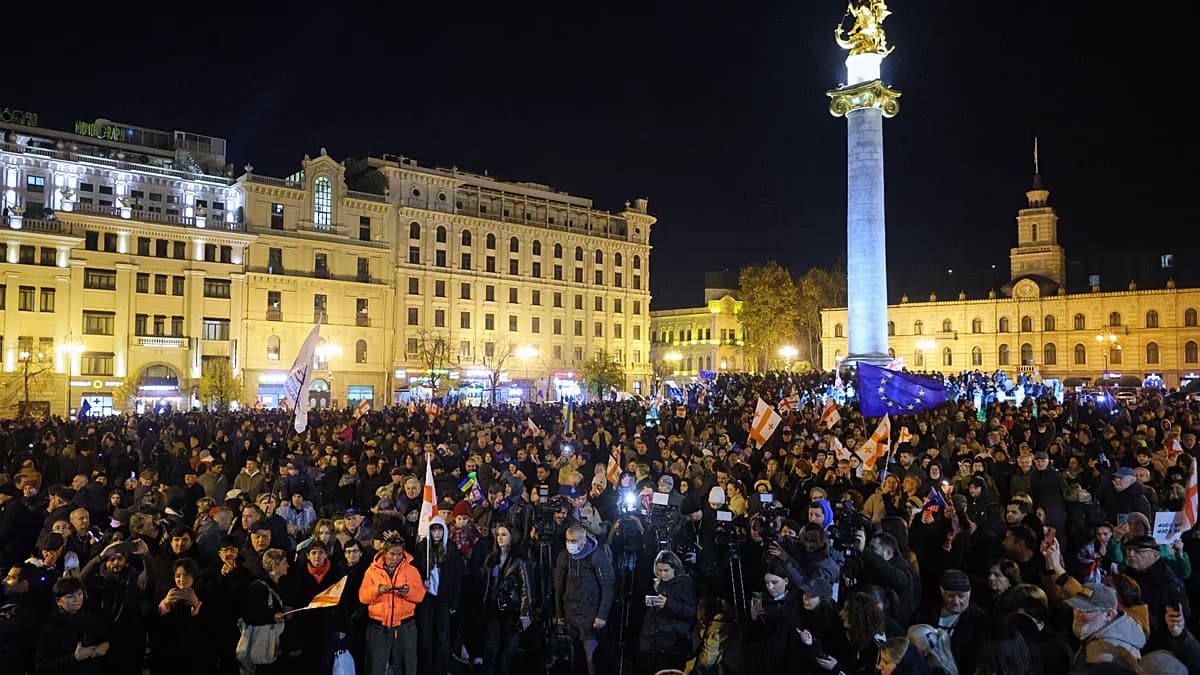
According to reports from Euronews, tens of thousands of demonstrators flooded the streets of Tbilisi on Saturday to mark two years of continuous opposition to the Georgian government's decision to freeze European Union integration. Waving both national and European flags, protesters filled the capital's main square to push back against a widening state crackdown on dissent and civil society.
The mass mobilization comes as the ruling Georgian Dream party moves to outlaw five major opposition factions, deepening a political chasm that has gripped the Black Sea nation since disputed parliamentary elections in October 2024.
For ordinary citizens across World News, the stakes are measured in daily freedoms, blocked futures, and the rising cost of political defiance. Prime Minister Irakli Kobakhidze suspended the country's EU accession track a month after the 2024 vote, igniting nationwide protests that officials met with heavy fines, mass arrests, and restrictive laws.
While the government defends its stance as a defense of local sovereignty, protesters argue that the policy deliberately steers a proudly pro-Western population toward international isolation.
Two Years of Street Protests and State Clampdowns in Tbilisi
The anniversary rally caps a grueling two-year endurance test for Georgia's civic movement. Since late 2024, daily demonstrations have persisted despite tear gas, water cannons, and aggressive police interventions designed to break the momentum of the opposition. Amnesty International reports that thousands of citizens have faced arbitrary detention, with over 150 individuals imprisoned following trials critics label as politically motivated.
At Saturday's gathering, participants voiced a stubborn refusal to abandon their European ambitions despite the personal risks involved. Musicians, students, and workers crowded into the public square to demand fresh elections and the unconditional release of jailed activists. The demonstrations highlight a profound disconnect between an administration tightening its grip on power and a populace that overwhelmingly supports integration with Western institutions.
Natela Mujiri on the Resolve of Georgian Demonstrators
Protesters maintain that the government's aggressive tactics will not extinguish public demand for democratic reform and European alignment. Street-level resilience remains high even as state pressure intensifies across the capital and regional hubs.
Police squads frequently deploy perimeter blocks and chemical irritants to clear public squares, yet crowds quickly reassemble down nearby avenues. Local volunteers distribute goggles and saline solutions from residential windows while merchants provide shelter during sudden evening raids. This underground logistical network keeps the movement breathing beneath a heavy layer of police surveillance.
We need to show that we won't bow to pressure and that we'll keep fighting for Georgia's European future for as long as it takes.
— Natela Mujiri, Musician
Giorgi Sartania on the Threat of International Isolation
Younger Georgians argue that the ruling party's trajectory threatens the country's economic and security future. Critics point out that while approximately 80 percent of the population favors EU membership, state policies actively sabotage that constitutional mandate.
Economic indicators reflect the growing cost of this political friction as foreign direct investment slows down. University graduates face limited career prospects inside state structures if they express dissenting views online or join weekend rallies.
"It's leading Georgia towards disaster. It has to go," 19-year-old student Giorgi Sartania told AFP regarding the current administration.
The Diverging Realities of Brussels and the Ruling Party
While citizens rally for a return to the European path, official rhetoric from Tbilisi presents a starkly different narrative. Prime Minister Kobakhidze insisted on Friday that his administration remains committed to joining the bloc, claiming his government is ready to begin accession talks immediately. Yet, he simultaneously ruled out repealing controversial foreign influence and NGO registration laws that European officials view as incompatible with democratic standards.
Brussels has responded with mounting alarm to the democratic backsliding in Tbilisi. EU Enlargement Commissioner Marta Kos bluntly described Georgia as a candidate country only on paper, noting that the nation has fallen far behind fellow aspirants Moldova and Ukraine. European leaders have repeatedly condemned the ruling party's efforts to muzzle independent media and civil society organizations under the guise of protecting traditional family values.
Financial Leverage and Suspended Diplomatic Channels
European capitals have started freezing direct budgetary support earmarked for government ministries while redirecting funds toward independent journalism groups. Diplomats in Brussels warn that visa-free travel privileges for Georgian passport holders could face suspension if authorities proceed with further crackdowns. Tbilisi officials dismiss these financial penalties as foreign interference in domestic legal affairs.
State television broadcasts nightly segments accusing Western embassies of plotting color revolutions through local non-governmental organizations. This official messaging feeds a polarization campaign that targets human rights lawyers, investigative reporters, and university professors. Consequently, working relationships between Georgian state agencies and European delegations have nearly broken down completely.
Constitutional Battles and the Threat of an Opposition Ban
The domestic political crisis entered a dangerous new phase last month when Georgia's Constitutional Court began hearing a case brought by Georgian Dream to outlaw five major opposition parties. Authorities accuse these political groups of attempting to subvert the constitutional order, a move the European Parliament warns will definitively sever Georgia's ties with the EU.
Independent legal experts view the ban as an attempt to dismantle institutional checks and balances entirely.
Although authorities recently pardoned seven imprisoned protesters, Kobakhidze conditioned future releases on detainees showing remorse and admitting guilt. This conditional clemency has done little to appease a skeptical public or quiet international critics who monitor the steady erosion of civil liberties. As the political standoff continues into its third year, the gap between official declarations and street-level reality widens with every passing week.
Judicial Overreach and the Fate of Detained Activists
Legal analysts point out that the state prosecutor's office relies on vague statutes regarding public safety to secure swift convictions in municipal courts. Defense attorneys report being barred from examining key digital evidence during pretrial hearings overseen by appointed magistrates. Families of jailed activists organize weekly vigils outside the penitentiary walls to demand transparency from a judiciary viewed as entirely compromised.
The upcoming court rulings on party dissolutions will determine whether Georgia retains a pluralistic legislature or shifts into a de facto single-party state. Opposition leaders vow to maintain underground coordination networks if formal political registration is stripped away by judicial decree. Law enforcement agencies maintain high alert status across Tbilisi as citizens prepare for another round of street confrontations.
The Morning Brief
One email a day with the stories that matter. Free, forever.
No spam. Unsubscribe anytime.
Comments (0)
Be the first to share your thoughts.