
Spanish Prime Minister and Conservative Rivals Make Final Push Ahead of Close Election
Spain's main party leaders held final rallies ahead of Sunday's election, with Socialist Prime Minister Pedro Sánchez vowing to defy the polls.
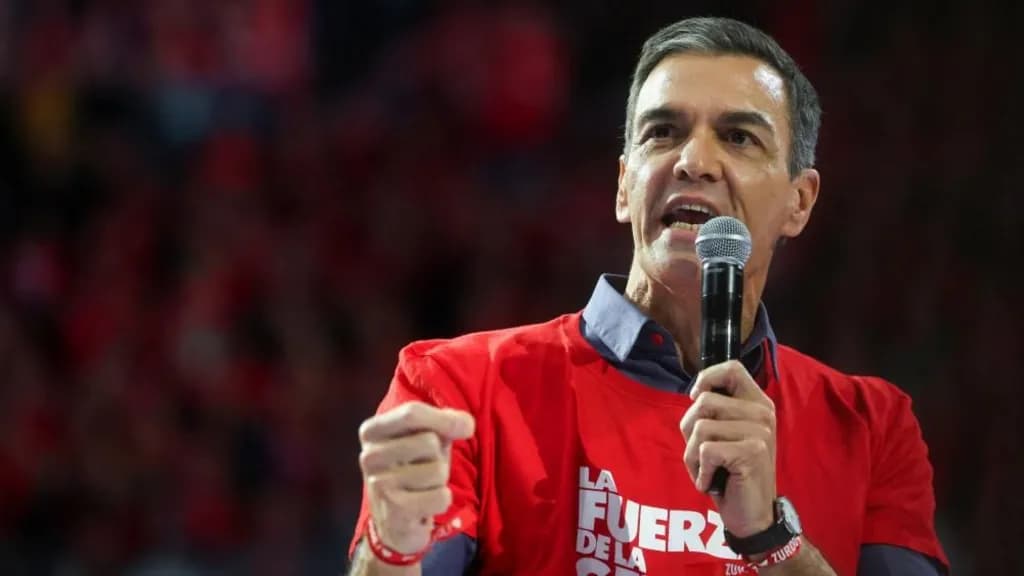
According to myjoyonline.com, Spain's major party leaders staged high-stakes final rallies ahead of Sunday's national vote, as Socialist Prime Minister Pedro Sánchez pressed an uphill battle against conservative momentum. With nearly 39 million eligible voters set to cast ballots, the campaign's closing hours exposed deep ideological fractures across the country.
Conservative challenger Alberto Núñez Feijóo holds a narrow lead in public polling, threatening to upend one of Western Europe's remaining left-wing administrations. Both major camps converged on contrasting electoral strategies in regional strongholds during the final stretch. Sánchez leaned into progressive mobilization in Madrid, while his conservative opponent divided time between Barcelona and Seville to secure vital parliamentary math.
The Socialist Defensive and the Polls
The incumbent government faced a stiff political headwind as the final campaign hours ticked down across the Iberian Peninsula. Socialist strategists deployed every available resource to close the gap before polling stations opened on Sunday morning.
Defying Expectations in the Capital
Prime Minister Sánchez struck a defiant note during his closing address in the capital, appearing alongside his wife while wearing a red campaign T-shirt emblazoned with the slogan "power of the people." Despite trailing in pre-election surveys published before a mandatory legal blackout period, the incumbent leader insisted that his administration would defy expectations. Socialist supporters rallied around warnings of a conservative shift that could align mainstream politics with far-right factions.
Surrounded by supporters in red T-shirts taking selfies, Sánchez dismissed the conservative lead as transient. He appealed directly to undecided urban voters who feared a rollback of labor reforms and social spending. Campaign organizers hoped that a last-minute surge in turnout among younger demographics might offset the steady polling advantage enjoyed by their rivals.
I cannot imagine us losing,
— Pedro Sánchez, Prime Minister of Spain
He used his final platform to attack Feijóo's willingness to govern alongside anti-immigration forces, framing the choice as a binary battle between social progress and a regression to historical authoritarianism.
Scandals and Rhetorical Clashes
The final day of campaigning unfolded directly in the shadow of a contentious four-way television debate. The broadcast featured sharp exchanges over national debt, immigration enforcement, and housing policy, alongside a flashpoint over gender politics. Feijóo had used the diminutive term "calladita" toward leftist politician Ada Colau during the debate, drawing immediate accusations of sexism from the prime minister and his allies.
That televised clash amplified existing tensions over legislative measures protecting sexual freedom and domestic abuse penalties. Socialist candidates hammered the conservative record on women's rights at every campaign stop following the incident. Conservative headquarters countered by accusing the left of manufacturing cultural distractions to deflect attention from rising living costs and inflation.
Image: myjoyonline.comConservative Strategy and Andalusian Calculations
Alberto Núñez Feijóo's People's Party (PP) focused its final hours on economic governance and a promised political era defined by what the challenger termed "truth, decency and good governance." Feijóo targeted the Socialist administration over corruption allegations, immigration management, and recent infrastructure failures. Ending his campaign in Seville underscored the strategic importance of Andalusia, a southern region holding 61 seats in the 350-seat national parliament.
The Regional Precedent in Andalusia
Andalusia represents a critical proving ground for conservative governance because regional authority is already shared between the PP and the far-right Vox party. Feijóo has maintained that he prefers a single-party majority supported by parliamentary agreements rather than a formal coalition cabinet with Vox. However, voters across Spain remain deeply divided on the implications of integrating the anti-immigration party into national governance structures.
Local rallies in Seville drew enthusiastic crowds waving regional and national banners under the Andalusian sun. Party managers poured considerable financial resources into southern districts where unemployment figures historically run higher than the national average. This regional push aimed to break the traditional Socialist dominance in Spain's rural and semi-urban southern municipalities.
Polling Realities and Voter Shifts
Public surveys indicate a tightly contested finish that could mirror broader political realignments across Europe. Disillusioned former Socialist voters, such as retired pensioner Isabel who attended her first PP rally, pointed to competent economic management as their primary motivation for switching sides. Conversely, young voters and progressive organizers warned that a conservative victory would dismantle hard-won social protections and women's rights.
Pollsters noted a distinct volatility among voters aged 18 to 35 who felt squeezed by high youth unemployment and stagnant wages. While the left warned against the perils of nationalist politics, the right focused on tax cuts and bureaucratic streamlining. Both sides spent the final night analyzing demographic shifts in key provinces where a few thousand ballots could swing entire congressional delegations.
Image: myjoyonline.comFar-Right Momentum and the Vox Rally in Valencia
Santiago Abascal's anti-immigration party Vox held its final rally inside a packed bullring in Valencia, filling the venue with green banners and Spanish flags. The event highlighted the hardline nationalist platform that could form the parliamentary backbone of a future right-wing government. Supporters cited border security concerns, referencing summer migration pressures in Ceuta as proof of government weakness.
Secretary General Ignacio Garriga drew thunderous applause with appeals prioritizing native citizens for welfare allocations and calling for tighter cultural restrictions. While party organizers defended their nationalist platform as an expression of patriotism, the broader polarization of the electorate ensures that Sunday's outcome will redefine Spain's political direction for years to come.
The rally atmosphere in Valencia contrasted sharply with the disciplined podium speeches delivered by the major establishment parties. Chants of national pride echoed through the amphitheater as organizers projected final vote tallies onto large digital screens. Ballot counters across all 52 electoral districts prepared for a long election night once the voting booths finally locked their doors.
The Morning Brief
One email a day with the stories that matter. Free, forever.
No spam. Unsubscribe anytime.
Comments (0)
Be the first to share your thoughts.