
Spanish PM Pedro Sanchez Defies Polls as Snap General Election Campaign Wraps Up
Spanish Prime Minister Pedro Sánchez insists internal data points to a left-wing majority despite polls favoring a conservative and far-right coalition.
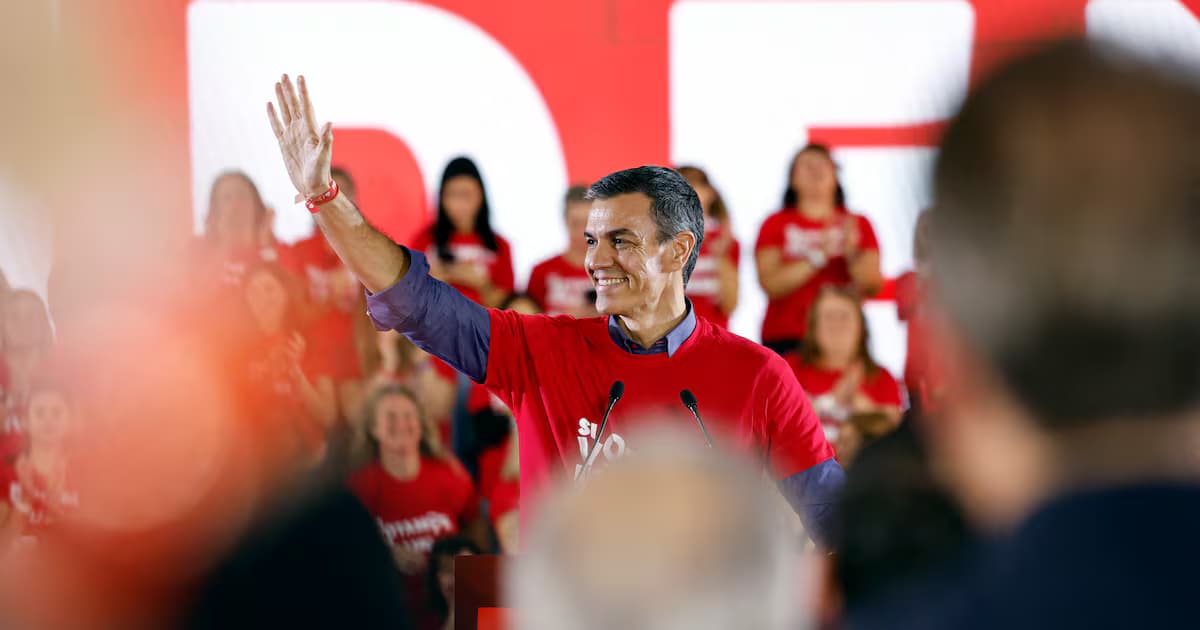
According to The Irish Times and international wire reports, Spanish Prime Minister Pedro Sánchez insisted on Friday that he would secure a left-wing majority in Sunday's snap general election despite adverse public polling. As political parties prepared to wrap up their campaigning, the Socialist leader maintained that internal data pointed toward a victory that would allow him to clinch re-election with smaller leftist allies.
The closing hours of the campaign unfolded under a strict legal ban on publishing opinion surveys. Sánchez used his final media appearances to project absolute confidence in his administration's political survival after eight years in power.
The Voting Mechanics Driving Spain's Parliamentary Math
Securing a majority government in Spain's 350-member congress requires hitting the threshold of 176 seats. That numerical target depends heavily on how votes play out in smaller provinces, where the country's D'Hondt electoral system traditionally favors larger political parties. The mechanics of seat distribution mean that small shifts in regional turnout can dramatically alter the final parliamentary balance without requiring massive nationwide swings.
Provincial Vulnerabilities and Turnout Targets
Both major blocs spent the final week of the race targeting marginal districts where past elections were decided by narrow margins. In 2023, the loss of roughly 600,000 votes in marginal provinces cost Vox roughly a third of its seats, leaving party leadership determined to avoid a repeat. Far-right leader Santiago Abascal toured more than 30 cities and towns in recent weeks to shore up local support.
Coalition Arithmetic and the Right-Wing Challenge
Nearly all public polls released before the blackout period showed a clear advantage for a potential coalition between the conservative People's Party and Vox. The PP currently polls at around 30 to 31 percent, while Vox estimates sit at 17 to 18 percent of the vote. That combined projection provides a viable pathway to national government if regional seat allocations break in their favor.
Balancing Domestic Pressures Across Regional Strongholds
National candidates directed heavy messaging toward provincial districts where minor swings decide entire legislative delegations. Party strategists deployed local figures to sway undecided voters in agricultural and industrial hubs alike. These localized pushes often determine whether minority factions win the critical final seat in contested constituencies.
I can’t conceive of us losing.
— Pedro Sánchez, Prime Minister of Spain
Sánchez added that left-leaning voters were increasingly mobilizing to turn out in droves, which he framed as a fundamental prerequisite for reaching a progressive majority. That parliamentary bloc would need to tackle pressing domestic challenges, including the country's deep housing crisis and immigration pressures that have dominated political debate across the World News landscape.
Image: irishtimes.comFinal Debate Clashes and Campaign Closing Rallies
During a four-way debate against opposition leaders and the candidate for the hard-left Broad Front, Sánchez adopted a combative posture. He teamed up with his expected junior coalition partner, Broad Front's Ada Colau, to criticize PP chief Alberto Núñez Feijóo and Vox's Santiago Abascal. Both leftist leaders argued that conservative proposals represented a dangerous return to past policies.
Confronting Controversial Rhetoric on the Stage
The debate featured sharp exchanges over gender-based violence and emergency management following recent natural disasters. Sánchez and Colau condemned Abascal for refusing to explicitly condemn gender-based violence during the broadcast. They also attacked Feijóo over a remark targeting Colau, which critics labeled sexist.
Feijóo later addressed the controversy directly on the campaign trail, attempting to smooth over the fallout while pivoting back to policy attacks.
Closing Logistics and the Mandatory Day of Reflection
Each campaign organized massive final rallies to energize core bases before the weekend ballot. The Socialists and Broad Front gathered supporters in central Madrid venues, drawing thousands of enthusiastic partisans. Meanwhile, conservative leaders rallied regional crowds in Seville and Valencia to maximize local momentum.
If I have bothered anyone, I withdraw (the remark), of course.
— Alberto Núñez Feijóo, People's Party Chief
Following the debate, the campaigns prepared distinct geographic strategies for their final rallies on Friday evening. The Socialists and the Broad Front scheduled their closing events in Madrid, while the PP and Vox stationed their final gatherings in Seville and Valencia respectively, ahead of Saturday's mandatory day of reflection.
Image: irishtimes.comTactical Shifts and Separatist Posturing in the Final Hours
To broaden its electoral appeal, Vox pursued an unconventional strategy in regional strongholds by appealing to followers of separatist factions. At a recent rally in Catalonia, Abascal even shouted local slogans, prompting questions about the party's core nationalist platform.
Political analysts view the rhetorical pivot as an electoral maneuver rather than an ideological shift. Observers note that the outreach highlights the intense competitive pressure governing the final days of the Politics cycle.
Assessing the Far-Right's Regional Outreach
Academic observers tracked these unusual campaign maneuvers closely as voting day approached. Shifting local messaging in historically hostile territory carries clear risks for traditional nationalist platforms. Yet desperate electoral math often forces campaign managers to test unorthodox voter coalitions.
“This is purely tactical. Vox is still convinced separatist parties have no space in Spanish politics,” Guillermo Fernandez, political science researcher and professor at Complutense University of Madrid, said.
Final Ballot Decisions Facing the Electorate
Millions of citizens will sort through competing claims when polling stations open across the country on Sunday morning. Election monitors expect high scrutiny over municipal turnout records and provincial seat tallies. Local authorities have deployed security personnel to ensure peaceful voting operations from major cities to rural hamlets.
Abascal has consistently rejected claims that his party has diluted its commitment to a unified Spanish state. As Spaniards enter the legally mandated day of reflection, voters must weigh these competing electoral visions before casting their ballots on Sunday.
The Morning Brief
One email a day with the stories that matter. Free, forever.
No spam. Unsubscribe anytime.
Comments (0)
Be the first to share your thoughts.