
Military Sweeps in Zamfara and Kaduna Neutralize Two Militants and Seize Uniform Stocks
Joint Task Force troops neutralized two terrorists in Zamfara and Kaduna, rescuing a kidnap victim and seizing dozens of military camouflage uniforms.
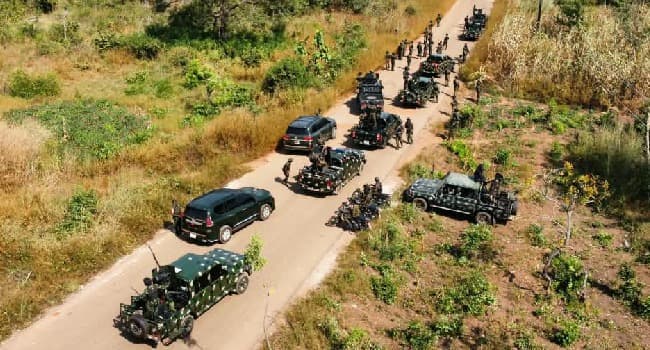
Conventional wisdom assumes military checkpoints alone choke insurgent supply lines across northwestern Nigeria, but recent field operations reveal a much more porous logistical underbelly. Two suspected terrorists were killed during separate operations in Zamfara and Kaduna states by troops of the Joint Task Force North West, Operation FANSAN YAMMA, according to Channels Television reporting.
Beyond the casualty count, the real story lies in the recovered quartermaster cargo intended to disguise insurgent units as regular state forces. These uniform seizures point to an underground manufacturing or theft ring supplying fighters with official patterns.
How Kucheri Operatives Intercepted the Camouflage Shipment
The tactical pivot began on Friday when Sector 2 operatives received actionable intelligence regarding a clandestine movement of military accoutrements through Kucheri, located in the Tsafe Local Government Area of Zamfara State. Insurgents rely heavily on stolen or replicated state uniforms to bypass civilian scrutiny at rural outposts and stage coordinated attacks. Troops laid an ambush along known transit routes, shifting the dynamic from reactive patrolling to targeted interdiction.
The Zamfara Quartermaster Seizure
During the brief firefight that followed the interception, two suspected militants were neutralized on the spot before they could unload their packs. A subsequent search of the immediate vicinity yielded a heavy cache of quartermaster gear destined for hidden encampments. Field reports confirmed the recovery of 26 assorted military camouflage uniforms, 26 matching T-shirts, and 54 camouflage jungle hats.
Logistics Multipliers and Rural Early-Warning Friction
This volume of tactical clothing represents far more than simple dress items; it serves as a critical multiplier for deceptive mobility. When irregular fighters blend into standard military patterns, local early-warning networks experience immediate friction, delaying civilian reporting and confusing response units.
The operation forms part of ongoing intelligence-led efforts to dismantle terrorists’ logistics networks and deny them access to supplies that could facilitate their nefarious activities.
— Tamuno Sinivie, Acting Media Information Officer, Joint Task Force (North West) Operation FANSAN YAMMA
Villagers who spot men in uniform walking through fields won't raise immediate alarms until it's too late. That delayed recognition buys criminal cells precious minutes to encircle rural settlements without triggering a coordinated defense.
Tactical Pursuit Dynamics in Kajuru Local Government Area
While Sector 2 secured the highway approach in Zamfara, Sector 1 units faced a simultaneous crisis hundreds of kilometers away in Kaduna State. Armed groups had raided the Kutura community in Kajuru Local Government Area, abducting residents and retreating into forested hideouts. Speed dictated the tactical window, forcing troops to transition instantly from static defense to active tracking.
Engaging the Kutura Kidnap Cell
Responding to a high-priority distress call, mobile platoons pushed directly into the forested terrain where the raiding party sought cover. The aggressive pursuit broke the cohesion of the captors, forcing them to abandon their positions under fire.
“The troops pursued and engaged the terrorists, forcing them to flee. A subsequent search of the general area led to the rescue of one of the kidnapped victims and the recovery of logistics materials from the terrorists’ hideout”, the official statement detailed. Search parties continue to comb adjacent sectors to locate remaining captives and track the fleeing cell leaders through unfamiliar bush tracks.
Forested Hideouts and Extraction Bottlenecks
Dense canopy cover in Kajuru severely limits aerial observation, forcing foot patrols to clear every ravine and rocky outcrop manually. Insurgent cells exploit these geographic barriers to split up captives into smaller groups, complicating rescue operations.
Troops must balance speed with caution to avoid triggering ambushes along narrow bush trails. Every successful extraction requires precise timing between ground units pushing forward and reserve platoons securing extraction corridors.
Image: channelstv.comOperational Pressures and Regional Security Realities
The dual strikes highlight the grinding reality of Security operations across the northwestern corridor, where insurgent groups constantly adapt their supply vectors. Logistics chains rely on decentralized couriers who move small batches of provisions rather than massive convoys, making traditional surveillance difficult. Intercepting uniform parcels disrupts infiltration plans far more effectively than random patrols along paved arteries.
Intelligence Pipelines and Retaliation Risks
Command structures within Operation FANSAN YAMMA emphasize that community intelligence remains the primary engine behind these tactical wins. Civilian tip-offs allow mobile units to strike before contraband reaches deep-forest sanctuaries. Yet, sustaining this operational tempo demands continuous reinforcement of local outposts against retaliatory raids.
Informants take immense personal risks whenever they pass details about local supply drops to military handlers. Security forces must protect these intelligence networks by acting swiftly on tips before insurgent cells realize their couriers have been compromised.
Tracing the Source of Seized Camouflage Stocks
“Operation FANSAN YAMMA remains resolute in its commitment to combating terrorism and other forms of criminality across the North West”, military representatives added, urging citizens to maintain information channels. The tactical burden now shifts to intelligence analysts tasked with tracing the original source of the seized camouflage stocks before the next delivery cycle begins.
Investigators will examine serial numbers, textile weaves, and stitching styles to determine if the gear was diverted from official procurement channels or manufactured in illicit local sweatshops. Closing down these supply sources remains the only way to permanently strip insurgent units of their stolen identities.
The Morning Brief
One email a day with the stories that matter. Free, forever.
No spam. Unsubscribe anytime.
Comments (0)
Be the first to share your thoughts.