
US Military Repels Unidentified Drones Near British Airbase in Security Test
American forces deployed counter-drone technology this month to repel unauthorized unmanned aerial systems near a British airbase.
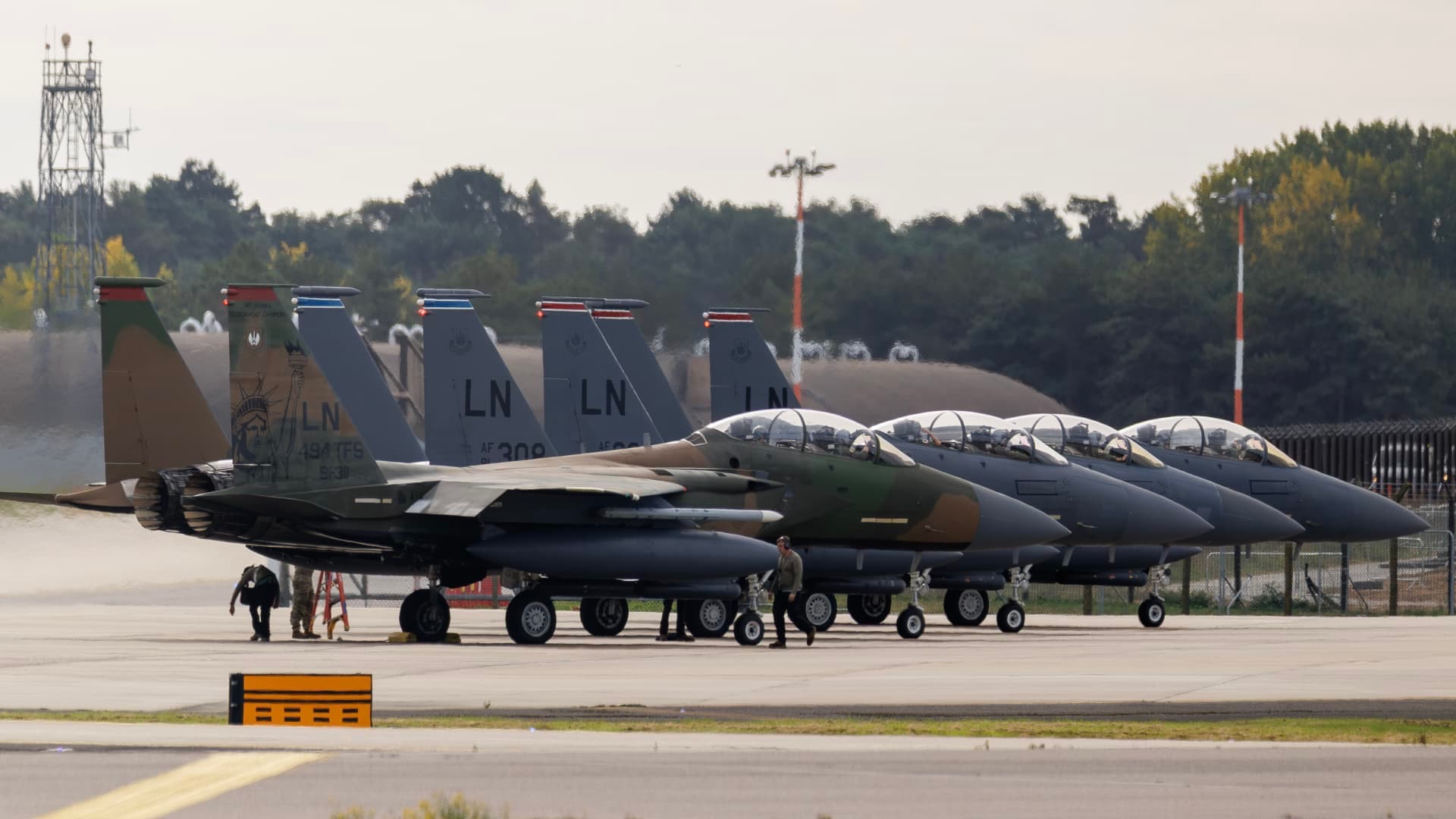
According to CNBC and the Financial Times, American military personnel deployed specialized counter-drone technology this month to repel unauthorized unmanned aerial systems near a British airbase. The security incident highlights rising vulnerabilities across allied military installations as low-cost aerial threats proliferate globally.
Details surrounding the precise timing, exact flight paths, and origin of the drones remain closely guarded by defense officials. The reported confrontation underscores mounting anxieties over airspace security at strategic logistics hubs across the World News landscape.
How Drone Proliferation Pressures Allied Airfields
Unmanned platforms have slipped into the gray zone between hobbyist gadgets and battlefield weapons. Their small size, off-the-shelf components, and ease of programming let adversaries conduct covert overflights without triggering conventional air-defense radars.
Deploying Counter-Unmanned Aerial Systems
American forces stationed abroad now rely heavily on integrated electronic jamming and kinetic interception tools to secure local perimeters. When the unidentified drones approached the British facility, operators activated these rapid-response systems to neutralize the intrusion before any damage occurred.
Two primary layers protect the sky: a radio-frequency disruptor that blinds the drone’s control link, followed by a handheld net-launcher that physically captures any rogue craft that evades the first barrier. The combination shortens engagement windows from minutes to seconds.
Electronic Jamming vs. Kinetic Options
Electronic attacks can shut down a drone’s navigation without creating debris, but they risk spilling interference into nearby civilian bands. Kinetic tools—such as directed-energy blasters or small-caliber railguns—guarantee a hard kill but demand precise targeting to avoid collateral damage.
Base commanders therefore weigh the likelihood of civilian fallout against the urgency of denying an intelligence-gathering platform. In the British incident, the electronic layer succeeded, allowing the kinetic system to stay on standby.
Protecting Critical Strategic Logistics Hubs
Airbases across the United Kingdom serve as vital staging grounds for transatlantic transport, refueling, and intelligence operations. Any persistent aerial surveillance threat forces commanders to reevaluate baseline Security postures and harden base defenses against asymmetric strikes.
Logistics hubs often host high-value assets, including stealth fighters and satellite-uplink equipment. A single drone that photographs a parked aircraft can feed a foreign analyst a detailed silhouette, which in turn accelerates reverse-engineering cycles.
Beyond hardware, the presence of hostile drones erodes confidence among allied personnel. Pilots and maintenance crews report heightened alertness during routine sorties, a psychological cost that can ripple through mission readiness.
Operational Openness Versus Force Protection at Allied Bases
Military commanders face a difficult operational trade-off when confronting ambiguous airspace intrusions near civilian population centers. Activating electronic countermeasures risks disrupting local commercial communications and civilian aviation frequencies near busy regional airports.
Civilian Frequency Interference Concerns
When a jammer floods the spectrum, nearby towns can lose GPS navigation, emergency dispatch radios, or even broadband internet. Local authorities therefore demand advance notification before any high-power sweep, a process that can shave precious minutes off a response timeline.
In practice, base security teams run a quick spectrum-audit, isolate the offending band, and limit the jammer’s output to a narrow cone aimed at the threat. The tactic preserves civilian services while still denying the drone its command link.
Decision-Making Under Uncertainty
Prematurely engaging unknown drones can escalate regional tensions or expose classified defense frequencies to hostile foreign intelligence gatherers. Conversely, failing to intercept a surveillance platform risks the compromise of sensitive deployment schedules and parked aircraft configurations.
Commanders rely on a tiered decision matrix: visual confirmation, electronic signature analysis, and finally rules-of-engagement approval. The matrix forces a deliberate pause, ensuring that a false alarm does not trigger an unnecessary show of force.
Navigating Inter-Service Jurisdictional Boundaries
Defending overseas installations requires seamless tactical coordination between United States expeditionary units and host-nation civil authorities. British police and Ministry of Defence officials must jointly investigate ground-launch origins while American units manage active base perimeter defense.
Joint task forces embed liaison officers in each other's command centers, sharing real-time video feeds and telemetry logs. This cross-pollination speeds the identification of launch sites, which often sit just beyond the base fence in rural outskirts.
Broader Implications for Base Defense Doctrines
The incident at the British facility serves as a stark warning for defense planners managing fixed-site infrastructure worldwide. As commercial drone technology grows more sophisticated, military bases must adapt their defensive doctrines to counter distributed, low-altitude hazards.
Investigators continue to analyze telemetry data gathered during the interception to determine who operated the platforms. Meanwhile, allied defense commands are reviewing standard operating procedures to prepare for future airspace incursions.
Doctrinal Shifts in Counter-UAS Training
Training curricula now embed counter-UAS modules alongside traditional air-defense courses. Soldiers practice rapid-switching between electronic and kinetic tools on simulated swarm scenarios, a drill that mirrors the chaotic reality of multiple drones breaching a perimeter.
Instructors stress the importance of “kill-chain awareness,” a concept borrowed from missile defense that maps detection, identification, engagement, and assessment steps. The new focus shortens the decision loop from the former five-minute average to under thirty seconds.
Allied Coordination Frameworks for Drone Threats
NATO’s recent “Airspace Integrity” working group drafted a shared protocol for reporting unauthorized UAV activity. The protocol mandates a joint digital log, encrypted video uploads, and a 48-hour de-confliction window before any kinetic response is authorized.
Early adopters—such as the U.S. European Command and the UK Ministry of Defence—have already piloted the system during joint exercises in the North Sea. The exercises revealed gaps in data-format compatibility, prompting a fast-track software patch that now harmonizes telemetry streams.
Economic Pressures Behind Counter-Drone Procurement
Acquiring a full suite of counter-UAS equipment costs roughly $2 million per forward operating base, a figure that strains defense budgets already stretched by legacy platform upgrades. Some allies therefore explore commercial off-the-shelf solutions that can be fielded faster and cheaper.
However, off-the-shelf kits often lack the hardened encryption required for classified environments. The trade-off forces planners to balance immediate protection needs against long-term cybersecurity resilience.
Future Scenarios: Swarms and AI-Driven Drones
Experts warn that the next wave of threats will involve coordinated swarms guided by artificial-intelligence algorithms. A dozen cheap quadcopters could overwhelm a single jammer, forcing bases to layer defenses in depth.
To counter such swarms, researchers are testing autonomous interception drones that can chase and capture hostile UAVs mid-air. The technology remains in trials, but early tests show a 70 % success rate against randomly programmed targets.
As the British base incident demonstrates, the line between hobbyist hobby and hostile reconnaissance is blurring. Each new engagement pushes the armed forces to refine tactics, invest in adaptable tech, and tighten cooperation with host nations. The next unauthorized overflight may arrive tomorrow, and the response will already be rehearsed.
The Morning Brief
One email a day with the stories that matter. Free, forever.
No spam. Unsubscribe anytime.
Comments (0)
Be the first to share your thoughts.