
New ESA Hera Footage Reveals Stadium-Sized Crater on Asteroid Hit by NASA
New European Space Agency footage reveals a stadium-sized crater on Dimorphos, four years after NASA's historic planetary defense impact test.
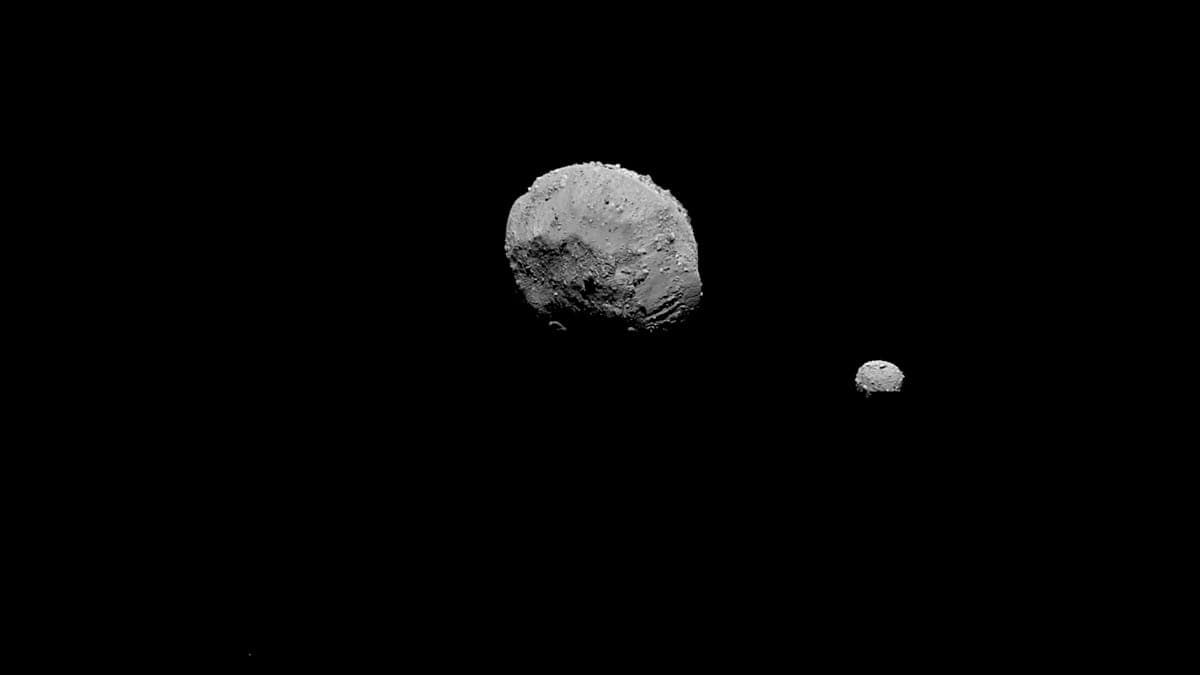
According to Euronews, the European Space Agency's Hera spacecraft has transmitted unprecedented close-up footage of the asteroid Dimorphos. Four years after NASA intentionally slammed a kinetic impactor into the space rock, fresh imagery confirms a stadium-sized scar marring its surface.
The impact site from the September 2022 Double Asteroid Redirection Test has flattened into a massive depression. This visual evidence marks a major milestone for Sci-Tech developments in planetary defense validation.
The Visual Evidence Captured by ESA Hera
Ground controllers at mission control centers across Europe spent weeks waiting for these high-gain transmissions to cross deep space. Now that the raw packets have cleared the downlink bottleneck, scientists are poring over the sharpest views yet of an altered celestial body.
Orbital Mechanics and Physical Deformation
The newly released telemetry gives researchers their first high-resolution look at the aftermath of humanity's initial planetary defense rehearsal. Dimorphos is captured circling its larger companion body, Didymos, revealing a profound structural alteration.
The side struck by the NASA probe has experienced catastrophic surface failure. Observers can clearly discern a crater spanning the width of a standard sports stadium.
Beyond the surface scar, the footage documents complex physical dynamics. The small asteroid continues to tumble erratically as it orbits its parent body, its spin state altered by the sheer force of the kinetic transfer.
Transit Dynamics in Binary Systems
The Hera spacecraft also recorded Dimorphos briefly passing into the dark shadow cast by Didymos. These fleeting eclipses provide essential photometric data for calculating mass distribution and surface cohesion across both bodies.
Scientists rely on these orbital transits to measure density shifts following the high-speed collision. The original 2022 impact successfully shortened the moonlet's orbital period around Didymos by roughly 33 minutes.
Tracking these subtle timing shifts allows physicists to calculate the exact momentum transfer efficiency. Every passing week of telemetry refines the orbital decay models built by teams on Earth.
Broader Implications for Planetary Defense Infrastructure
What began as a high-risk kinetic intervention has now yielded empirical benchmarks for future risk mitigation. Ground operators use these data streams to refine computer models for asteroid deflection missions before any actual planetary threat materializes.
Validating Kinetic Impactor Physics
Space agencies previously depended entirely on ground-based telescopic light curves to infer surface changes. Direct imaging from Hera replaces theoretical assumptions with physical measurements.
The scale of the crater indicates that porous rubble-pile asteroids react differently to hypervelocity impacts than solid rock bodies. Engineers must incorporate these structural realities into subsequent Security architectures designed to protect Earth from incoming NEOs.
Instead of acting as a solid billiard ball, Dimorphos absorbed the impact by shedding loose gravel and lofting a massive plume of dust. That porous energy dissipation changes how physicists calculate the mass required for future interceptors.
Global Tracking and Future Intercept Scenarios
International consortia are currently reviewing the Hera dataset to calibrate future intercept timelines. A shorter warning window requires precise knowledge of how much kinetic energy is needed to divert a threatening trajectory.
As data processing continues, planetary scientists are mapping the ejected debris field that settled across the binary system. This scattered rubble field poses unique gravitational puzzles for any follow-up missions.
Mission planners now know they cannot treat small Near-Earth Objects as homogenous targets. The Hera findings demand a complete overhaul of how interceptor mass and impact velocity are calculated against loose conglomerate bodies.
Engineering Lessons from Deep Space Reconnaissance
Building a spacecraft capable of rendezvousing with a tiny binary asteroid system pushes the absolute limit of deep-space navigation. Flight dynamics teams had to account for irregular gravitational fields that shift with every rotation of the Didymos-Dimorphos pair.
Navigation Challenges Near Small Bodies
Conventional orbital insertion strategies fail entirely around low-mass objects because the gravitational pull is too weak to hold a traditional satellite lock. Hera relies on autonomous optical navigation routines to calculate its position relative to the surface features.
Onboard cameras track boulders and crater rims in real time to adjust the thruster burns without waiting for round-trip speed-of-light commands from Earth. This autonomous tracking technology will likely form the backbone of future automated interceptor probes.
Data Transmission Bottlenecks and Deep-Space Comms
Streaming gigabytes of high-resolution imagery across millions of kilometers requires heavy reliance on NASA's Deep Space Network and ESA's own tracking stations. Antenna time is tightly rationed among dozens of active interplanetary missions competing for bandwidth.
Engineers compress the telemetry heavily before transmission, balancing data fidelity against the risk of packet loss across solar interference corridors. Every successful downlink represents weeks of scheduling discipline and signal amplification.
Translating Asteroid Data into Policy and Funding
Raw scientific discovery rarely translates into immediate public policy without a clear operational framework. Space agencies must now convince national budget authorities to fund permanent asteroid survey networks based on what Hera uncovered.
Securing Long-Term Funding for NEO Surveys
Ground-based telescopes spot thousands of new near-Earth objects every year, but tracking their precise orbits requires dedicated space telescopes like NASA's upcoming Near-Earth Object Surveyor. The Hera findings prove that knowing an asteroid's size isn't enough; we need to know its internal structure before we launch a deflection mission.
Lawmakers in various capitals are reviewing these post-impact metrics when allocating next-year space budgets. A well-documented proof-of-concept makes it significantly easier to justify multi-billion-dollar planetary defense expenditures to skeptical taxpayers.
International Coordination and Warning Protocols
No single nation possesses the radar networks and spacecraft fleet required to monitor every threatening rock in the solar system. The Hera mission data is shared openly among international partners through established committees under the United Nations framework.
When an actual impact threat is finally detected decades from now, decision-makers will rely on the deflection efficiency formulas derived from the Dimorphos crash. The margin between a successful orbital nudge and a catastrophic miss will be calculated using the exact crater dimensions currently being mapped by Hera.
The Morning Brief
One email a day with the stories that matter. Free, forever.
No spam. Unsubscribe anytime.
Comments (0)
Be the first to share your thoughts.