
Military Helicopter Crash in Peru Leaves Eight Dead During Remote Valley Rescue Mission
Eight military personnel died in a helicopter crash during a rescue mission in Peru's VRAEM valley, leaving the pilot as the sole survivor.
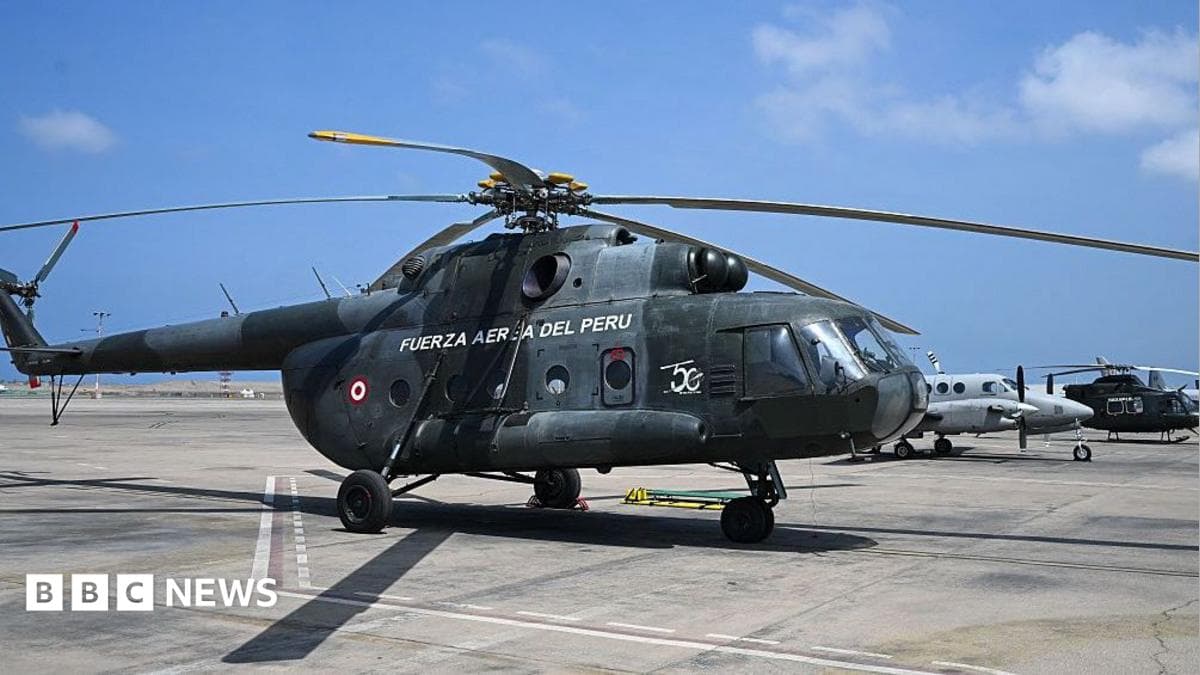
According to BBC reporting, eight military personnel lost their lives when a Peruvian armed forces helicopter went down near the town of Sanabamba. The tragic accident occurred during an ongoing evacuation mission in the high-risk Apurimac, Ene, and Mantaro river valley region. Ordinary families across the nation now face the stark human cost of operations in these volatile borderlands.
Rescue teams confirmed that pilot Enzo Espinoza Roque survived the violent impact as the sole survivor. The Ministry of Defence acted quickly to airlift the injured pilot to Lima for specialized medical intervention. This incident lays bare the daily hazards faced by security forces operating in deep jungle terrain.
Mapping the Strategic Hazards of Cocaine Valley
The crash site sits directly inside Peru's most notorious coca-growing territory, a rugged corridor plagued by armed cartels and rebel remnants. For local communities, the presence of state aircraft represents both a fragile shield and a lightning rod for violence. Ground units rely entirely on air support to navigate hostile terrain where roads remain primitive or nonexistent.
Geography and Cartel Presence
The VRAEM basin twists through steep canyons, dense canopy and fast-moving rivers that limit ground patrols. Cartel factions exploit these natural defenses, setting up hidden camps that blend into the forest floor. Their control over the coca economy fuels a parallel war that forces the military to operate at the edge of logistical reach.
Operational Pressures on VRAEM Special Command
Military planners face immense operational friction when attempting evacuations under hostile fire or unpredictable weather patterns. The VRAEM Special Command coordinates counter-narcotics sweeps that frequently require split-second extraction decisions. Transport units operate at peak strain with aging airframes and limited backup options across vast distances.
Air Support as Lifeline
Helicopters provide the only rapid link between remote outposts and medical facilities in Cusco or Lima. When a rotorcraft fails, troops lose not only firepower but also a critical evacuation channel. The loss of a single aircraft can strand dozens of soldiers for days, increasing exposure to ambushes and disease.
The Heavy Toll on Regional Families
Families back home shoulder the immediate emotional burden when routine troop rotations turn deadly in remote river basins. Communities in garrison towns across Peru absorb the grief while demanding better protective gear for front-line troops. Grief-stricken relatives are left questioning why extraction protocols carry such staggering risks.
Image: bbc.co.ukWeighing the Balance of Institutional Accountability
Military leadership now faces mounting public scrutiny regarding fleet safety standards following consecutive major aviation disasters. Senior commanders must balance urgent tactical necessities against the stark reality of mechanical attrition and pilot fatigue. Investigators have yet to determine whether mechanical failure or external interference triggered the Sanabamba tragedy.
search and rescue operations located the aircraft and the nine military personnel who were on board
— Ministry of Defence, Government of Peru
Maintenance Record Gaps
Past audits revealed that several UH-1H and Mi-17 helicopters exceeded their service life without comprehensive overhauls. Spare parts shortages force crews to cannibalize components from grounded airframes, a practice that erodes reliability. The Sanabamba crash may become the catalyst for a fleet-wide inspection program.
Political Repercussions
Opposition lawmakers have filed motions demanding a parliamentary inquiry into defense procurement practices. Public rallies in Lima feature banners that read “Lives over budgets.” The government risks a confidence dip ahead of the upcoming regional elections if corrective steps appear half-hearted.
deepest condolences to the family members, friends, and comrades-in-arms of the members of our VRAEM Special Command who lost their lives while carrying out a military mission. May God keep them in His glory
— Joint Command of the Peruvian Armed Forces, Military Command
Public trust in state security operations hangs in the balance as civilian watchdogs demand full transparency on fleet airworthiness. Families of the fallen soldiers expect clear answers about why previous maintenance warnings didn't prevent this disaster. Taxpayers watching the crisis unfold are asking if defense budgets truly prioritize crew survival over basic territorial patrols.
Image: bbc.co.ukGovernment Reaction and Policy Review
President Dina Boluar announced a temporary suspension of non-essential flights over the VRAEM corridor while a technical board reviews the incident. The decree also authorizes emergency funds to replace the most vulnerable helicopters within six months. Critics argue that short-term fixes will not address deeper procurement flaws.
Immediate Safety Measures
All operational pilots now undergo a mandatory 48-hour rest period after any night sortie. Maintenance crews received a directive to log every component swap in a centralized digital registry. These steps aim to reduce fatigue-related errors and improve traceability of parts.
Long-Term Modernization Plans
The defence ministry has drafted a multi-year plan to acquire 12 new rotary-wing platforms equipped with night-vision and anti-collision systems. Funding will be split between the national budget and a loan from the Inter-American Development Bank. If approved, the upgrade could reshape aerial capability in the high-risk valleys.
Examining the Broader Regional Safety Deficit
Peru shares responsibility with neighboring Colombia for managing vast cocaine production zones that distort local economies and fund insurgencies. State forces must project power into lawless river valleys where traffickers possess advanced weaponry and rapid communication networks. Every downed aircraft diminishes the operational reach of federal authorities trying to secure vulnerable border populations.
Cross-Border Coordination
Joint patrols with Colombian units have increased by 15 % over the past year, focusing on interdiction points along the Putumayo River. Intelligence sharing relies on satellite feeds that can be jammed by cartel-owned drones. Strengthening these links could reduce the frequency of surprise attacks on military convoys.
Impact on Civilian Mobility
Rural markets depend on occasional charter flights to move produce and medical supplies. When a helicopter crashes, those lifelines disappear, forcing villagers to trek days through muddy tracks. The resulting shortages raise food prices in nearby towns and fuel resentment toward both the state and illicit groups.
Institutional Tributes and Immediate Aftermath
The Joint Command of the Peruvian Armed Forces released a solemn digital tribute honoring the fallen personnel who perished in the line of duty. Community leaders in affected districts are organizing memorial services while awaiting official crash investigation findings from Lima inspectors. State authorities must now decide how to adjust patrol frequencies without surrendering critical ground to armed trafficking networks.
Public pressure will likely force a comprehensive audit of military transport readiness before the rainy season complicates flight paths further. Ordinary citizens living near active conflict zones continue to bear the collateral risks of a protracted, high-stakes drug war. State officials face a narrow window to prove that front-line personnel will receive safer equipment and reliable air cover moving forward.
The Morning Brief
One email a day with the stories that matter. Free, forever.
No spam. Unsubscribe anytime.
Comments (0)
Be the first to share your thoughts.