
Linux KVM Flaw Exposes 127 GB of Host Memory on AMD Cloud Servers
A Linux KVM bug let attackers read 127 GB of host memory from a guest VM on AMD cloud servers, forcing providers to patch and users to reassess virtualization settings.
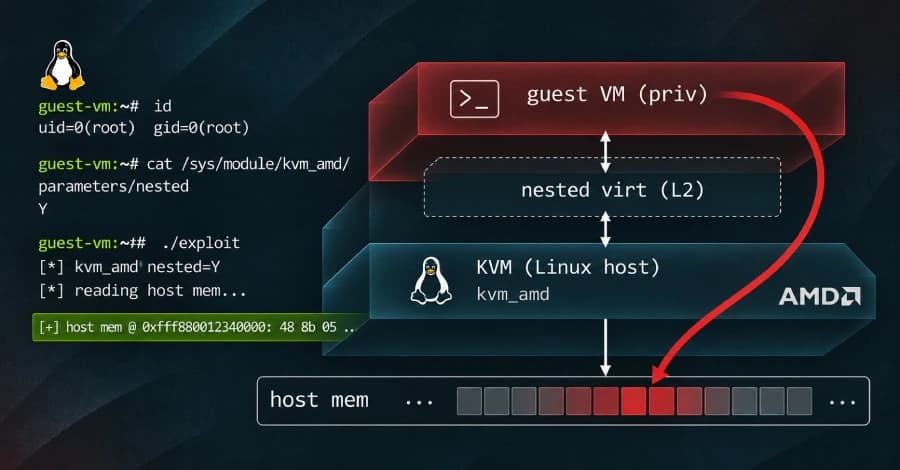
According to The Hacker News, researchers were able to read roughly 127 GB of a DigitalOcean server’s RAM from inside a guest virtual machine running on an AMD processor.
On a shared cloud server that memory can belong to other customers’ workloads, meaning a single compromised VM could spill secrets from dozens of unrelated tenants. The flaw, catalogued as CVE‑2026‑99312, resides in the KVM hypervisor’s nested‑virtualization code path and only affects hosts that run AMD CPUs with that feature enabled.
Why it matters
Virtual machines are supposed to be isolated containers that keep one tenant’s data separate from another’s. When that isolation breaks, attackers can harvest encryption keys, proprietary code, or personal data stored in memory. In the test performed on a DigitalOcean Droplet, the guest VM first displayed the host’s kernel version banner and then streamed 127 GB of read‑only host RAM to the attacker’s console. The ability to read that much memory from a single VM is unprecedented in recent cloud‑security research.
How the vulnerability works
KVM uses a nested page table to translate a guest’s virtual addresses into the host’s physical memory. For each virtual CPU, the hypervisor stores a pointer to this table. When a nested VM – a VM running inside another VM – receives an INIT reset signal, KVM is supposed to restore the outer VM’s pointer before the reset completes. The buggy code fails to do so on AMD platforms, leaving the pointer aimed at a page that the kernel has already freed.
Once the kernel re‑allocates that freed page, the guest can overwrite it with forged entries. The processor then follows those forged entries as if they were legitimate, effectively granting the guest arbitrary access to any physical page on the host. By populating the forged table with entries that map to the host’s RAM, the researchers were able to dump about 127 GB of memory.
Scope and impact across cloud providers
The exploit requires three conditions: an AMD‑based host, KVM with nested virtualization enabled, and a malicious guest with root privileges. Intel‑based hosts are not vulnerable because the faulty code exists only in the AMD branch of KVM’s nested‑virtualization implementation.
DigitalOcean confirmed that the bug worked on its own infrastructure and classified the issue as critical. The provider applied a live patch to its fleet and reassured customers that no action was required on their part. Other surveyed cloud operators had not enabled nested virtualization on AMD hardware, so they were not exposed.
Distribution kernels lag behind the upstream fix. As of the article’s publication, Debian’s security tracker lists all stable releases as vulnerable, with a fix only in the unstable branch. Ubuntu rates the flaw as High and has not released a patched package. Red Hat marks Enterprise Linux 9 and 10 kernels as affected, postponing the fix, while Enterprise Linux 8 is unaffected. This patch gap leaves many on‑premise and private‑cloud operators still at risk.
Mitigation steps and patch timeline
The upstream Linux kernel incorporated a fix on Tuesday, November 2, in stable kernel 7.3.5 and the long‑term branches 6.18.64 and 6.12.118. The change forces KVM to reset the nested‑virtualization state on every INIT signal, eliminating the dangling pointer.
Operators of AMD KVM hosts must either update the host kernel to a version that contains the fix or disable nested virtualization entirely. Disabling the feature is as simple as setting options kvm_amd nested=0 and rebooting, but it also disables the ability for a guest to run its own VMs – a capability relied upon by some development and testing workloads.
Because the vulnerability lives in the host kernel, updating the guest operating system does nothing. The host must be rebooted with the patched kernel for the protection to take effect. Cloud providers that can apply live patches, like DigitalOcean, can protect customers without downtime, but private operators will need scheduled reboots.
What’s next for cloud security
Security researchers warn that the KVM bug is the latest in a series of isolation failures disclosed this year, including a 16‑year‑old shadow‑memory flaw and the PwnEscape vulnerability in Linux’s networking stack. Each incident underscores the difficulty of maintaining robust VM isolation as hypervisor code grows more complex.
For tenants, the immediate takeaway is to verify whether their provider runs AMD hosts with nested virtualization enabled. If the provider does not publish that detail, customers can request confirmation or demand that nested virtualization be disabled unless explicitly needed.
From a broader perspective, the incident illustrates how a security fix can unintentionally introduce new bugs. The offending code originated from a 2022 patch that addressed a different nested‑virtualization issue (CVE‑2022‑3344) but omitted the page‑table pointer reset, leaving the defect dormant for nearly four years.
Industry observers expect that kernel maintainers will scrutinize recent patches more closely and that cloud operators will adopt more aggressive patch‑testing pipelines. Until then, the best defense remains timely kernel updates and careful configuration of virtualization features.
The Morning Brief
One email a day with the stories that matter. Free, forever.
No spam. Unsubscribe anytime.
Comments (0)
Be the first to share your thoughts.