
Treasury Secretary Says It's Too Soon to Judge Nvidia CEO Jensen Huang's Return
Treasury secretary says it's premature to decide if Nvidia CEO Jensen Huang should return, as Scott Bessent demands answers on Chinese chip sales.
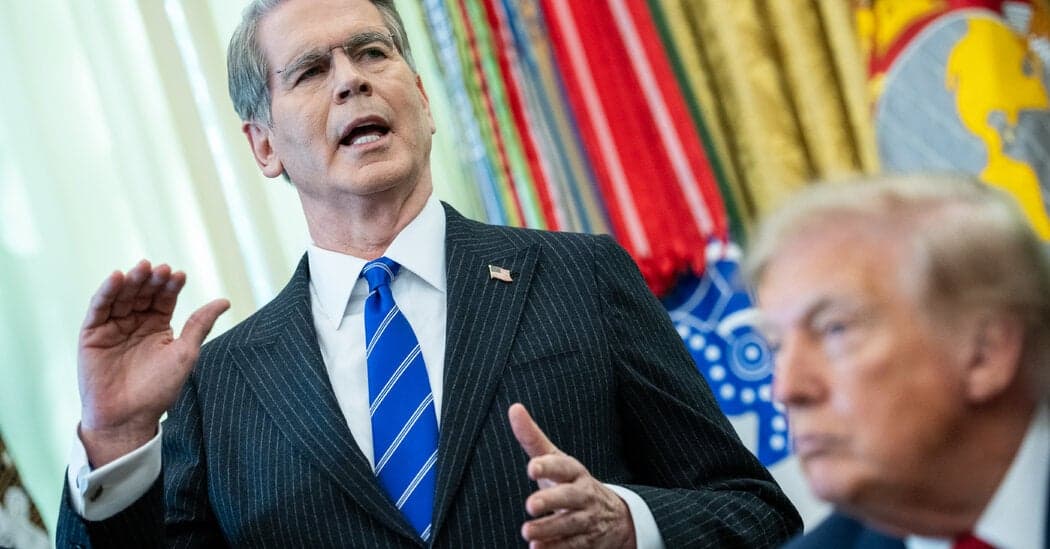
According to the New York Times, Scott Bessent publicly urged Nvidia to clarify its chip sales to China, while the U.S. treasury secretary told CBS that it remains premature to decide whether Jensen Huang should resume his role as chief executive.
The remarks arrived amid lingering uncertainty over Nvidia's compliance with export controls and the broader geopolitical tension surrounding advanced semiconductor technology.
Why the statement matters
When the treasury secretary emphasizes that a decision on Huang's leadership is “too soon,” it signals that the administration is still gathering information. The comment also underscores the sensitivity of Nvidia’s dealings with China, a market that has drawn scrutiny from U.S. regulators.
Scott Bessent’s call for transparency adds pressure on the company to disclose details about its Chinese chip shipments. While the specific content of those sales is not detailed in the source, the demand for answers reflects a broader push for corporate accountability in high‑tech exports.
The significance of the treasury secretary’s caution goes beyond a single executive appointment. In recent years, the United States has tightened export‑control regimes to prevent advanced semiconductors and related software from reaching entities that could use them for military or surveillance purposes. Those rules, codified in the Export Administration Regulations, require firms to obtain licenses for shipments that exceed certain performance thresholds. Because Nvidia’s GPUs power everything from artificial‑intelligence research to data‑center workloads, any ambiguity about whether a particular shipment required a license can quickly become a matter of national security.
Scott Bessent, known for his work in investment management and his occasional forays into public policy commentary, is not a regulator but a market participant whose voice carries weight on Wall Street. His request for clarity taps into a growing expectation that companies operating at the cutting edge of technology must be forthright about where their most powerful products end up. In practice, that means providing regulators with detailed end‑use statements, supply‑chain documentation, and, when asked, a public accounting of the volume and value of chips sent to jurisdictions that are under heightened scrutiny.
By framing the issue as one of “prematurity,” the treasury secretary also signals to Congress and to the broader business community that any hasty punitive action could have ripple effects across the entire semiconductor ecosystem. The United States relies on a delicate balance: it wants to protect its technological advantage while avoiding a wholesale decoupling that could harm American innovation, supply‑chain resilience, and the very companies that generate tax revenue and high‑paying jobs.
Implications for Nvidia and the tech sector
Should further evidence emerge about Nvidia’s activities, the treasury secretary’s stance could evolve, potentially influencing policy decisions that affect the entire semiconductor industry.
For now, the company’s leadership remains in a holding pattern, awaiting clearer guidance from regulators and lawmakers.
If investigators were to find that Nvidia inadvertently or deliberately bypassed licensing requirements, the consequences could range from fines and export‑license denials to more severe penalties such as restrictions on future sales to the United States government. Such outcomes would not only impact Nvidia’s bottom line but also send a warning to other chipmakers that the era of “soft‑landing” compliance is ending.
The semiconductor sector is uniquely interdependent. Foundries in Taiwan, design houses in the United States, and equipment suppliers in Europe all rely on a predictable regulatory environment. A shift in policy that tightens export rules for a single player could force companies to redesign products, re‑engineer supply chains, or even relocate research and development activities to jurisdictions with clearer rules. In turn, that could accelerate the broader trend of “friend‑shoring,” where firms concentrate production in allied countries to mitigate geopolitical risk.
From a market perspective, investors watch regulatory headlines as closely as they watch product roadmaps. A lingering cloud over Nvidia’s leadership could affect stock volatility, especially given the company’s outsized weighting in major indexes. Moreover, because Nvidia’s GPUs are a foundational component for emerging AI workloads, any disruption in its ability to sell to a large market like China could slow the deployment of AI services worldwide, with downstream effects on cloud providers, autonomous‑vehicle developers, and scientific research institutions.
At the same time, the United States government is keen to avoid a scenario where a single policy decision pushes a high‑tech firm to relocate critical capabilities abroad. The treasury’s measured tone reflects an awareness that the broader strategic goal is to maintain a competitive edge without triggering a retaliatory trade response that could close off American markets to Chinese consumers and businesses.
What comes next
Analysts will watch for any forthcoming statements from Nvidia or additional testimony from Treasury officials. The next steps will likely involve more detailed disclosures and possibly formal inquiries.
Until then, the focus stays on whether Jensen Huang will be reinstated as chief executive and how Nvidia will address concerns about its Chinese chip sales.
In the weeks ahead, the most probable developments include a formal request from the Committee on Foreign Investment in the United States (CFIUS) or the Department of Commerce for a deeper audit of Nvidia’s export records. Such a request would be routine in cases where a company’s products are deemed “dual‑use,” meaning they have both civilian and military applications. A thorough audit could result in a public filing that details the number of units shipped, the end‑user certifications, and the licensing status of each transaction.
Concurrently, Nvidia’s board is expected to convene a special session to discuss the treasury secretary’s comments. In past instances, boards of technology firms have responded by commissioning independent compliance reviews, hiring external legal counsel, and, when necessary, adjusting internal governance structures to tighten oversight of export‑control functions. The outcome of such a session could either reinforce confidence in Jensen Huang’s continued leadership or prompt a temporary delegation of duties to an interim chief while the investigation proceeds.
Outside of the immediate corporate response, Congress may schedule hearings where senior officials from the Treasury, Commerce, and State departments testify about the broader policy framework. Those hearings often become a forum for bipartisan debate on how to balance national security with the economic benefits of open markets. Legislators may introduce bills that clarify licensing thresholds for AI‑accelerating hardware, thereby providing the industry with more predictable rules.
Finally, the global tech community will be watching for any ripple effects on related supply chains. Companies that supply memory, interconnects, and cooling solutions to Nvidia’s GPUs could find themselves subject to the same scrutiny, prompting them to review their own export‑control compliance programs. The cumulative effect of these actions could reshape how the entire ecosystem approaches transparency, documentation, and risk management when dealing with high‑sensitivity markets.
In summary, the statements from both Scott Bessent and the treasury secretary have set the stage for a multi‑layered process that will involve corporate disclosures, regulatory reviews, and potentially legislative action. The next few months will be critical in determining whether Nvidia can navigate the scrutiny without significant operational disruption, and whether Jensen Huang’s stewardship will continue unimpeded or be temporarily altered while the United States clarifies its stance on advanced chip exports to China.
The Morning Brief
One email a day with the stories that matter. Free, forever.
No spam. Unsubscribe anytime.
Comments (0)
Be the first to share your thoughts.