
COP31 Collapses as Fractured Talks Fail on Fossil Fuels and Finance
COP31 talks in Turkey ended without a central political accord as disputes over fossil fuels and contested adaptation finance derailed the longest summit in UN history.
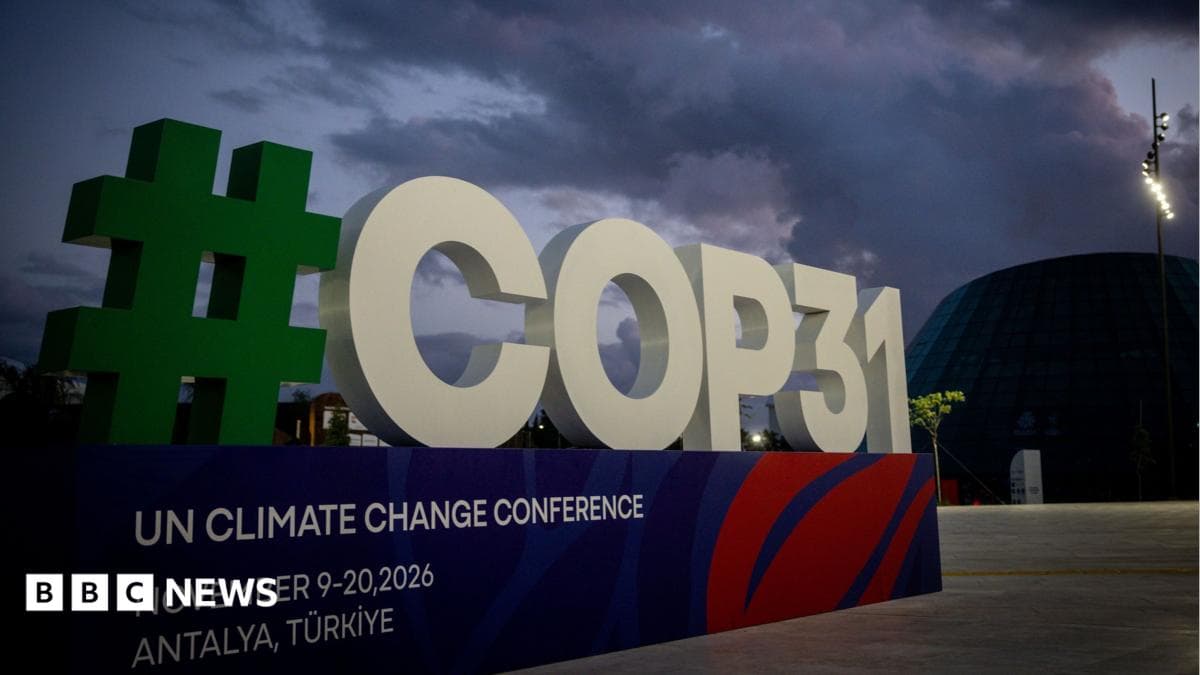
Exactly 164 secondary agenda items survived the negotiating rooms in Antalya, but the decisive figure defining the summit was zero. According to BBC reporting on the collapse of COP31, the longest-running climate talks in United Nations history ended without adopting their central political agreement, the Antalya Pacts, after delegates walked out over omitted fossil fuel language and disputed funding obligations.
The summit concluded amid acute environmental signals, following a year marked by glacier collapses, record European heatwaves, and catastrophic wildfires across Asia. Jointly hosted by Turkey and Australia, the conference aimed to establish an implementation framework. Instead, geopolitical fractures derailed negotiations, exposing a widening gulf between physical climate realities and multilateral consensus.
Disagreements peaked during an acrimonious final session. Several delegations abandoned the plenary after the draft text excluded any direct reference to fossil fuels, while developed economies refused to lock in concrete numerical baselines for adaptation finance. The breakdown leaves the global diplomatic process facing unprecedented scrutiny over its operational viability.
Why It Matters: The 1.5C Boundary and Quantified Risk
This summit marked the first convening since the UN confirmed that average global temperatures will exceed the 1.5C threshold established in the 2015 Paris Agreement. The draft text openly acknowledged that international action has fallen short of its primary thermal guardrail. While participating states repeatedly cited the 1.5C limit as their guiding benchmark, the physical boundary is no longer theoretical.
The distinction between 1.5C and 2C involves measurable physical consequences documented by the Intergovernmental Panel on Climate Change (IPCC). A 0.5C variance represents a 10cm rise in global sea levels, a margin that places an estimated 10 million additional people at direct risk of coastal flooding. At 2C, ocean acidification threatens irreversible marine degradation, and extreme heat events are projected across every inhabited region on Earth.
"This COP sought to confront hard truths – that global warming is set to overshoot 1.5C and that we must act with even more urgency to reduce emissions," stated UK Energy Secretary Miatta Fahnbulleh at the conclusion of the talks. The draft text introduced carbon dioxide removal (CDR) into a draft COP outcome for the first time, framing technological and natural sequestration as necessary tools to compress the duration of any atmospheric overshoot.
Natural removal methods like afforestation face strict boundaries regarding geographical scale and long-term storage permanence. Technical solutions exist on paper, but remain technically unproven at scale and heavily contested by participating delegations.
The Finance Ledger: The Contested Triple and Geopolitical Gridlock
Diplomatic fractures were equally pronounced across the financial balance sheet. Wealthy nations failed to establish a specific monetary target for future adaptation aid to developing nations, despite previous commitments to triple adaptation financing from a $40 billion (approximately £30 billion) baseline by 2035. The fundamental accounting mechanisms and conditions governing that calculation remain completely unresolved.
The impasse highlighted how fragile previous multilateral agreements can be when tested by geopolitical friction. Three years after governments endorsed transition language at COP28 in Dubai, negotiators in Turkey proved unable to reaffirm that baseline in the Antalya Pacts. The failure of international politics to maintain previously settled consensus threatens the fundamental mechanism of UN climate treaties.
Australian Climate Minister Chris Bowen, who co-led the proceedings, underscored the shifting international landscape. "The situation coming into this COP was the most complicated and fraught geopolitical environment in living memory," Bowen observed following the gavel.
Tensions surfaced in open plenary exchanges. European Union representative Darragh O'Brien argued that negotiations had been "hijacked by some oil states" intent on stripping emissions sources from the final document. Russian representative Sergei Kononuchenko addressed European diplomats directly in English, criticizing their reliance on loan structures for adaptation funding and describing it as "an old colonial distribution of labour under a new banner."
Market Acceleration Versus Multilateral Paralysis
Despite the high-profile failure of the headline pacts, the conference did process operational rules across its wider slate. Delegates advanced a just transition framework to protect industrial workforces and agreed that proceeds generated through a global carbon crediting mechanism will be directed toward developing country adaptation funds. However, the overarching work programme intended to drive actual emissions cuts collapsed and was deferred to COP32.
Outside the plenary, institutional dynamics are increasingly dictated by economic pressure rather than diplomatic consensus. Analysis from the International Energy Agency (IEA) highlighted that disruptions across the Strait of Hormuz constitute the largest energy supply shock in modern history. The structural volatility of fossil fuel transit routes has accelerated incentives for domestic clean energy deployment, aligning economic security directly with climate imperatives.
Projections indicate global renewable capacity will expand 60% faster over the next six years than during the preceding cycle. Solar generation, storage batteries, and electric transport continue to gain commercial market share based on price competition alone. This shifts significant weight away from political communiqués toward practical capital deployment.
"We are not entering the age of electricity, we have arrived at the age of electricity," IEA Executive Director Fatih Birol told reporters during the summit, pointing out that national business and finance calculations now prioritize energy sovereignty over negotiated treaty timelines.
Data Caveat: What the Market Numbers Do Not Prove
It is tempting to view market momentum as a total substitute for multilateral agreements, but quantitative analysis exposes the limits of this view. A 60% acceleration in renewable energy expansion does not equate to an automatic, equivalent reduction in aggregate atmospheric emissions. Commercial adoption of clean technologies often occurs alongside continued fossil fuel extraction rather than directly replacing it.
Furthermore, capital deployment remains bottlenecked by physical constraints that market prices cannot independently resolve. Dr Jennie Dodson of the World Business Council for Sustainable Development warned that commercial parity alone cannot drive rapid decarbonization. Corporate deployment continues to encounter severe structural roadblocks, particularly regarding electrical grid capacity, interconnections, and statutory permitting approvals.
What Happens Next: An Aging Machinery
For three decades, UN climate summits operated primarily as legislative drafting chambers, culminating in the 2015 Paris Agreement. COP31 demonstrated the strains of converting broad diplomatic promises into operational economic mandates. When national budgets, resource extraction rights, and debt instruments enter the equation, consensus-driven systems struggle to deliver unified policy.
The unfinalized work programme on emissions reductions will now carry over to COP32, forcing host nations to confront identical fractures over fossil fuel wording and adaptation capital. Whether consensus diplomacy can retain authority while commercial markets accelerate and global temperatures cross statutory limits remains the unresolved test facing future summits.
The Morning Brief
One email a day with the stories that matter. Free, forever.
No spam. Unsubscribe anytime.
Comments (0)
Be the first to share your thoughts.